
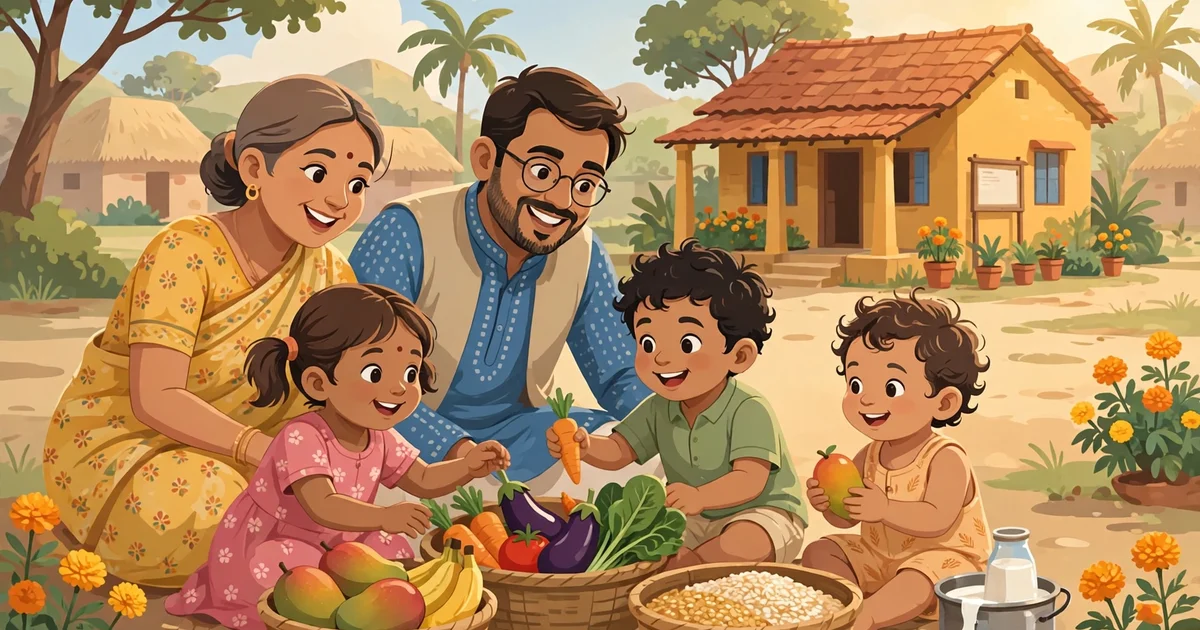
The simple answer to “What is Poshan?” is: Poshan is the Hindi word for nutrition, and also the name of India’s national mission against malnutrition in children, pregnant women, and new mothers. “Poshan Abhiyaan” and “Mission Poshan 2.0” both refer to the Government of India’s flagship nutrition programme.
Poshan Abhiyaan launched in March 2018 as the National Nutrition Mission, uniting many departments, technology tools, and community programmes under one umbrella. In the Union Budget 2021–22 it merged with the Integrated Child Development Services (ICDS — India’s Anganwadi network) to form Mission Saksham Anganwadi and Poshan 2.0, anchored by the Ministry of Women and Child Development.
👉 Parents can check their child’s growth against World Health Organization (WHO — the agency that sets global child-growth standards) benchmarks with the free Poshan Calculator — no download needed.
In this article, you will understand:
- What “Poshan” means and where the mission’s name comes from
- The goals, targets, and beneficiaries of Poshan Abhiyaan
- How Mission Poshan 2.0 works today, including the Poshan Tracker app
- Simple ways your family can support the mission
What is Poshan? Breaking Down the Word Itself
Poshan (पोषण) is Hindi for nourishment or nutrition — the proteins, vitamins, minerals, and energy from food that help children grow, stay active, learn, and fight illness. POSHAN stood for Prime Minister’s Overarching Scheme for Holistic Nourishment; Abhiyaan means campaign. In one sentence: Poshan is nutrition, and it is India’s national campaign to make sure every child and mother gets it.
Takeaway: Poshan = nutrition. Remember the word, and the mission’s purpose is obvious.
Why Did India Launch a National Nutrition Mission?
Malnutrition remains one of India’s biggest public health challenges. The National Family Health Survey (NFHS-5) found 35.5% of children under five were stunted — too short for their age, a sign of chronic undernutrition. Before 2018, nutrition programmes ran separately across departments. Poshan Abhiyaan brought them together — convergence, or many teams working as one — and added technology (the Poshan Tracker app) plus community campaigns like Poshan Maah.
Takeaway: India needed one coordinated mission because scattered programmes were not beating malnutrition.
What are the Targets of Poshan Abhiyaan?
The mission set clear annual targets: reduce stunting (low height for age) by 2%, undernutrition by 2%, low birth weight by 2%, and anaemia (low iron in the blood) by 3% per year, with continuous reduction in wasting (low weight for height). These cover children under six, pregnant women, lactating mothers, and adolescent girls — and every Anganwadi centre’s growth data feeds this national picture.
Takeaway: The mission runs on numbers that start with a weighing scale at your local Anganwadi centre.
Who Benefits from Poshan Abhiyaan?
The mission is universal and self-selecting — anyone eligible can join:
- Children under 6 — growth monitoring, supplementary nutrition, pre-school education
- Pregnant women — antenatal care, iron and folic acid tablets, supplementary nutrition
- Lactating mothers — support until six months after childbirth
- Adolescent girls (14–18) — nutrition support in Aspirational Districts and North-Eastern states
Supplementary nutrition comes as hot cooked meals and take-home rations under the National Food Security Act, 2013, with extra rations for children with Severe Acute Malnutrition (SAM — dangerously thin children).
Takeaway: If your family includes a young child or a pregnant or new mother, this mission is for you.
What is Mission Poshan 2.0? The Unified Mission
In Budget 2021–22, Poshan Abhiyaan merged with Anganwadi Services (ICDS) and the Scheme for Adolescent Girls into Mission Saksham Anganwadi and Poshan 2.0 — a Centrally Sponsored Mission funded by the Centre and implemented by states and union territories. It runs on three ideas: convergence (departments working together), technology (the Poshan Tracker app), and community ownership (Poshan Maah and Poshan Pakhwada campaigns). Two lakh Anganwadi centres are being upgraded as Saksham Anganwadis with better buildings, LED screens, water filters, Poshan Vatikas (nutrition gardens), and learning materials.
Takeaway: Poshan 2.0 is Poshan Abhiyaan grown up — bigger, more digital, closer to the community.
What is the Role of Anganwadi Centres in Poshan?
The Anganwadi centre is the mission’s beating heart. India has over 14 lakh village-level centres, each run by an Anganwadi worker with a helper and an ASHA (Accredited Social Health Activist — the village health worker). Centres provide supplementary nutrition, growth monitoring against WHO standards, health check-ups and referrals — including SAM (Severely Acute Malnourished) and MAM (Moderately Acute Malnourished) children — plus immunisation support and pre-school education. Workers now get smartphones with data recharge and growth monitoring devices (infantometers, stadiometers, weighing scales) for accurate digital records.
Takeaway: The Anganwadi centre is where the national mission meets your neighbourhood.
How Does the Poshan Tracker App Power the Mission?
The Poshan Tracker app is the mission’s digital backbone. Launched in March 2021, Anganwadi workers use it to register beneficiaries, record growth measurements, log home visits, and track services in near real time — about 8.95 crore beneficiaries as of March 2026. It also enables dynamic identification of stunting, wasting, and underweight, flagging faltering growth automatically so workers act early. State-wise numbers are public at poshantracker.in/statistics.
👉 Parents can do a simpler version of this check at home with the free Poshan Calculator — enter age, height, and weight to compare with WHO standards.
Takeaway: Poshan Tracker turns millions of village measurements into one national nutrition map.
What are Poshan Maah and Poshan Pakhwada?
Twice a year the mission becomes a festival. Poshan Maah (National Nutrition Month) is celebrated every September; Poshan Pakhwada (Nutrition Fortnight) runs two weeks, usually in March–April. The 9th Poshan Maah, launched 9 September 2026, carried the theme “Hamari Anganwadi, Hamari Jimmedari” — Our Anganwadi, Our Responsibility. Centres organise rallies, cooking demonstrations, growth-monitoring camps, and pledge ceremonies — together generating over 150 crore activities nationwide through this Jan Andolan.
Takeaway: September is nutrition month in India — watch for activities at your nearest Anganwadi centre.
What are Poshan Vatikas and Saksham Anganwadis?
- Poshan Vatikas — nutrition gardens at Anganwadi centres encouraging diet diversity and local produce; children learn where food comes from while centres get fresh greens.
- Saksham Anganwadis — upgraded centres with better infrastructure, LED screens, water filters, and Building-as-Learning-Aid (BaLA) paintings that turn walls into teaching tools.
Both share one belief: a child’s surroundings shape nutrition as much as any supplement.
Takeaway: The mission is not only about food packets; it is about healthier places for children.
How Can Parents Check Their Child’s Nutrition at Home?
You need not wait for a health camp — the same WHO growth standards workers use are in the free online Poshan Calculator:
- Open the Poshan Calculator on any phone or computer — no app to install.
- Enter your child’s age, sex, height (or length), and weight.
- See instantly whether growth is on track or needs attention.
- Discuss the result with your Anganwadi worker or doctor.
Important: The calculator is a screening aid, not a diagnosis. Only a trained health worker or doctor can confirm a nutrition problem and advise treatment.
Takeaway: Two minutes with the free tool today can start a helpful conversation about your child’s health.
Poshan Abhiyaan: Key Facts at a Glance
| Fact | Detail |
|---|---|
| Meaning of “Poshan” | Nutrition / nourishment (Hindi) |
| Full name | POSHAN Abhiyaan — Prime Minister’s Overarching Scheme for Holistic Nourishment |
| Launched | March 2018 |
| Current form | Mission Saksham Anganwadi and Poshan 2.0 (since Budget 2021–22) |
| Ministry | Ministry of Women and Child Development |
| Beneficiaries | Children under 6, pregnant women, lactating mothers, adolescent girls (14–18) |
| Delivery points | Over 14 lakh Anganwadi centres |
| Digital tool | Poshan Tracker app — ~8.95 crore beneficiaries (March 2026) |
| Annual campaigns | Poshan Maah (September), Poshan Pakhwada (March–April) |
👉 The mission starts at home: check your child’s growth with the free Poshan Calculator and join India’s nutrition movement.
FAQs
What is Poshan in simple words?
Poshan is the Hindi word for nutrition, and the name of India’s national mission against malnutrition in children and mothers.
When was Poshan Abhiyaan launched?
In March 2018 as the National Nutrition Mission; it merged into Mission Poshan 2.0 in 2021–22.
Who runs the Poshan mission?
The Ministry of Women and Child Development anchors it; states implement it through Anganwadi centres.
Is Poshan Abhiyaan only for poor families?
No — it is universal and self-selecting for all eligible children, pregnant women, lactating mothers, and adolescent girls.
How can I check my child’s nutrition status for free?
Use the free Poshan Calculator, which compares your child’s measurements with WHO growth standards in under two minutes.
Conclusion
So, what is Poshan? A simple Hindi word with a big promise: no child in India should miss the nutrients needed to grow, learn, and thrive. It is now one of the world’s largest nutrition programmes — but it works only when families take part.
👉 Start today: open the free Poshan Calculator, enter your child’s measurements, and take the first step toward a healthier future.