
Use the Poshan Calculator to instantly check your child’s height, weight, BMI, and nutrition status. Get accurate WHO-based results, including stunting, wasting, SAM, and MAM in seconds.
- Check child growth in under 5 seconds using the Poshan Calculator
- Based on the WHO child growth standards
- Detect SAM, MAM, stunting & underweight instantly
- Works for children aged 0–5 years
- No login, no app required
Select a tool below to instantly check your child’s growth using the Poshan Calculator based on WHO standards.
Poshan Calculator
Free child growth & nutrition tool — weight-for-age, BMI, stunting, wasting & SAM/MAM screening. For parents, Anganwadi & ASHA workers.
<18.5 Normal
18.5–24.9 Overweight
25–29.9 Obese
≥30
| Z-Score | Stunting (HFA) | Underweight (WFA) | Wasting (WFH) |
|---|---|---|---|
| Above +2 | Tall | Overweight | Obese |
| -1 to +2 | Normal | Normal | Normal |
| -2 to -1 | Mild Stunting | Mild Underweight | Mild Wasting |
| -3 to -2 | Moderate Stunting | Moderate Underweight | Moderate Wasting |
| Below -3 | Severe Stunting | Severe Underweight | SAM |
| Term | Hindi | Meaning |
|---|---|---|
| Stunting | बौनापन | Low height-for-age — chronic malnutrition |
| Wasting | दुर्बलता | Low weight-for-height — acute malnutrition |
| Underweight | कम वजन | Low weight-for-age — general undernutrition |
| SAM | गंभीर कुपोषण | Severe Acute Malnutrition — urgent NRC referral |
| MAM | मध्यम कुपोषण | Moderate Acute Malnutrition — supplementary food |
| MUAC | मध्य-ऊपरी भुजा | Mid-Upper Arm Circumference screening |
This Poshan Calculator follows the WHO (World Health Organisation) child growth standards used by health workers and government programs.
Trusted by Anganwadi workers, ASHA workers, and parents across India. Calculate weight-for-age, BMI, stunting, wasting, underweight, and SAM/MAM status instantly — using WHO-standard z-score tables. No login. No app. Completely free.
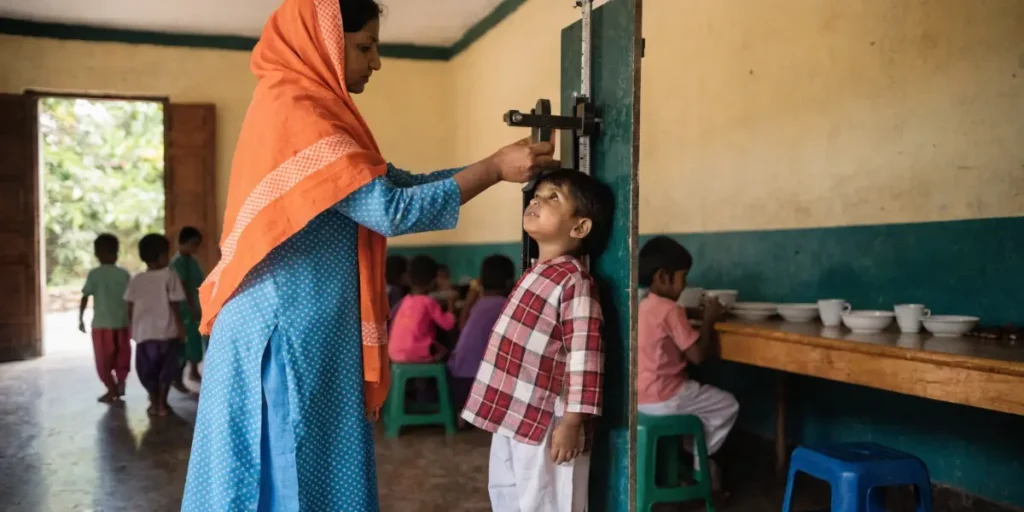
Updated 2026: All calculations use the latest WHO Child Growth Standards. Results are bilingual — available in English and Hindi (हिन्दी).
What is the Poshan Calculator?
The Poshan Calculator is a free online tool that assesses a child’s nutritional status using WHO (World Health Organisation) growth standards.
In a few seconds, it shows whether a child is normal, underweight, stunted, wasted, or showing signs of acute malnutrition — without charts, medical training, or government login.
You simply enter four details: gender, date of birth, height, and weight.
The tool compares these inputs with WHO reference data and generates z-scores for three key indicators:
- Height-for-age (HFA)
- Weight-for-age (WFA)
- Weight-for-height (WFH)
It also calculates BMI and supports MUAC-based screening for SAM and MAM.
Why this matters: India still carries one of the world’s highest burdens of childhood malnutrition. According to NFHS-5 (2019–21), 35.5% of Indian children under 5 are stunted, 19.3% are wasted, and 32.1% are underweight. The Poshan Calculator helps identify these children early — when intervention is still effective.
Poshan Calculator vs. Poshan Tracker App — What’s the Difference?
This is one of the most frequently searched questions on this topic. The answer is simple but important.
| Feature / Aspect | Poshan Calculator (this tool) | Poshan Tracker App (poshantracker.in) |
|---|---|---|
| Purpose | Calculator = instant growth assessment. | Tracker = official data recording system. |
| Login required? | No | Yes (OTP or staff credentials) |
| Who should use? | Everyone | ICDS department staff and registered beneficiaries |
| Platform | Any browser, any device | Android app only |
| Access | Free, open access. No login. Works for any parent, ASHA worker, or volunteer instantly. | Official government app. Requires department or beneficiary login. Used by Anganwadi staff for data entry and reporting. |
What Indicators Does the Poshan Calculator Measure?
This calculator covers all five key growth and nutrition indicators used by the Indian government, WHO, and UNICEF for assessing child health.
| Indicator | Full Form | Detects |
|---|---|---|
| HFA | Height-for-Age | Stunting — chronic malnutrition |
| WFA | Weight-for-Age | Underweight — general undernutrition |
| WFH / BMI | Weight-for-Height / BMI | Wasting — acute malnutrition |
| MUAC | Mid-Upper Arm Circumference | SAM / MAM — acute malnutrition |
| BMI | Body Mass Index | Overweight and obesity (all ages) |
Weight-for-Age (WFA) — Underweight Detection
Weight-for-Age (WFA) is one of the three core WHO growth indicators and the most commonly used measurement in Indian Anganwadi centres. It compares a child’s actual weight to the expected weight for a child of the same age and gender, according to WHO growth standards.
WFA is particularly important because it detects both chronic and acute undernutrition.
A child with low WFA is called underweight — a condition that significantly increases the risk of infections, poor brain development, and long-term developmental delays.
How Weight-for-Age is Calculated
The Poshan Calculator computes a WFA z-score using this formula:
WFA z-score formula: Z = (Child’s weight − WHO median weight for age) ÷ WHO standard deviation for age
The result is a z-score that tells you how many standard deviations the child’s weight is above or below the WHO median for their age group.
Weight-for-Age Classification Table
| WFA Z-Score | Classification | Action Required |
|---|---|---|
| Above +2 SD | Overweight | Monitor diet; avoid high-sugar, high-fat foods |
| -1 to +2 SD | Normal weight | Continue current nutrition and feeding practices |
| -2 to -1 SD | Mild underweight | Improve dietary diversity; recheck in 4 weeks |
| -3 to -2 SD | Moderate underweight | Enroll in SNP at Anganwadi; refer if no improvement |
| Below -3 SD | Severe underweight | Immediate NRC referral required — call 1800-180-1104 |
Real Example: Calculating Weight-for-Age
Example: Child: Rohan, Boy, 18 months old | Actual weight: 9.2 kg | WHO median for 18-month boy: 11.5 kg | WHO SD: 1.12 | WFA z-score = (9.2 − 11.5) ÷ 1.12 = −2.05 → Moderate Underweight. Action: Enrol in Anganwadi supplementary feeding. Recheck in 4 weeks.
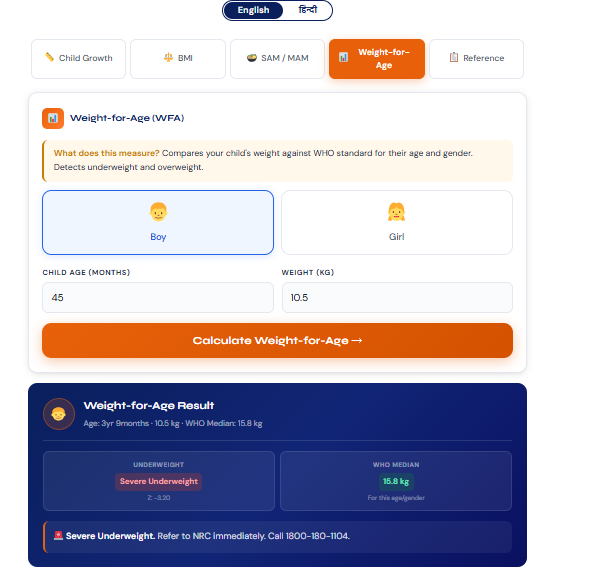
📌 Note: Weight-for-Age alone does not distinguish between a child who is short but proportionate (stunted but not wasted) versus a child who is thin for their height. For a complete picture, always check all three indicators: HFA, WFA, and WFH together.
Understanding Stunting, Wasting & Underweight — India’s Malnutrition Triple Burden
India faces what nutrition experts call a “triple burden” of malnutrition — stunting, wasting, and underweight — all three of which the Poshan Calculator can detect instantly. Understanding the difference between these three conditions is essential for parents, healthcare workers, and policymakers.
Stunting — Height-for-Age (HFA)
Stunting is when a child’s height is significantly lower than expected for their age. It is caused by chronic, long-term malnutrition — typically beginning in the womb and continuing through the first two years of life (the “first 1000 days“).
Stunted children may look proportionate, but are shorter than they should be for their age.
- Measured by: Height-for-Age (HFA) z-score
- Threshold: Below -2 SD from the WHO median
- In India: 35.5% of children under 5 are stunted (NFHS-5)
- Hindi: बौनापन (Bwanapan)
- Key risk period: Pregnancy through 24 months — the first 1000 days
- Long-term effects: Reduced cognitive ability, lower school performance, reduced adult earnings
Wasting — Weight-for-Height (WFH)
Wasting is when a child’s weight is too low relative to their height. Unlike stunting (which is chronic), wasting is an acute condition — it develops quickly and can be caused by illness, infection, or sudden food shortage.
Severely wasted children are at very high risk of death without immediate medical care.
- Measured by: Weight-for-Height (WFH) or BMI-for-Age z-score
- Threshold: Below -2 SD (moderate wasting); below -3 SD (SAM)
- In India: 19.3% of children under 5 are wasted (NFHS-5)
- Hindi: दुर्बलता (Durbalata)
- Urgent cases (WFH below -3 SD): Require NRC admission and therapeutic feeding
- Recovery: With proper treatment, wasting can be reversed within weeks
Underweight — Weight-for-Age (WFA)
Underweight is a composite indicator that reflects both chronic and acute malnutrition. An underweight child may be stunted, wasted, or both. It is the indicator most commonly used in Indian ICDS monitoring because it can be measured with a simple weighing scale.
- Measured by: Weight-for-Age (WFA) z-score
- Threshold: Below -2 SD from the WHO median
- In India: 32.1% of children under 5 are underweight (NFHS-5)
- Hindi: कम वजन (Kam Vajan)
- Anganwadi tool: Monthly weight recording is mandatory under ICDS
How Stunting, Wasting & Underweight Compare
| Indicator | Time frame | Reflects | Recovery time |
|---|---|---|---|
| Stunting | Chronic — months to years | Long-term food insecurity | Very slow (months to years) |
| Wasting | Acute — days to weeks | Recent food shortage or illness | Fast with treatment (weeks) |
| Underweight | Both acute + chronic | Overall nutritional status | Moderate (weeks to months) |
shorter than peers
visibly thin / low weight
low weight for age
are stunted
are wasted
are underweight
BMI Calculator — For Children and Adults
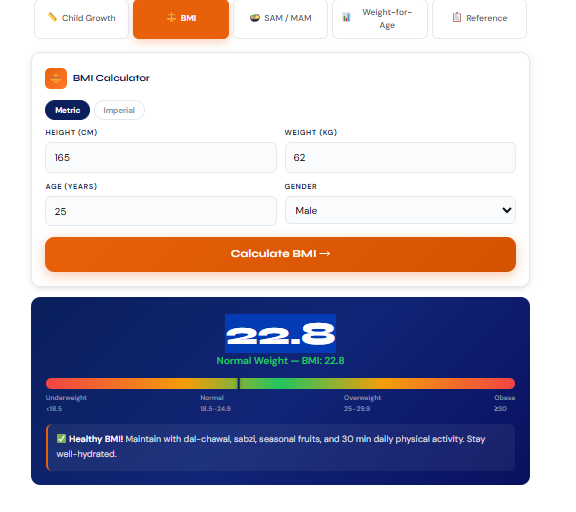
The Poshan Calculator includes a full BMI (Body Mass Index) calculator for both children and adults. BMI is calculated by dividing weight (in kg) by height squared (in metres²). It is a widely used screening measure for underweight, healthy weight, overweight, and obesity.
BMI for Children (BMI-for-Age)
For children aged 5 to 19 years, BMI must always be interpreted alongside age and gender — this is called BMI-for-Age.
The same BMI number that indicates a healthy weight in an adult may indicate undernutrition or overweight in a child, depending on their age and gender. The calculator automatically adjusts for this.
BMI-for-Age formula: BMI = Weight (kg) ÷ Height (m)² | Then compare against WHO BMI-for-Age reference charts
BMI for Adults
For adults aged 18 and above, standard WHO BMI cutoffs apply. India follows the same WHO thresholds, though some studies recommend lower thresholds (like 23 for overweight) for South Asian populations due to different body composition patterns.
| BMI Range | Classification | Recommended Action |
|---|---|---|
| Below 18.5 | Underweight | Increase caloric and nutrient intake; seek medical advice |
| 18.5 – 24.9 | Normal / Healthy weight | Maintain current diet and activity level |
| 25.0 – 29.9 | Overweight | Reduce calories; increase physical activity |
| 30.0 – 34.9 | Obese Class I | Medical consultation; structured weight management |
| 35.0 and above | Obese Class II/III | Urgent medical intervention required |
BMI for Pregnant and Lactating Women
For pregnant women, standard BMI cutoffs do not directly apply due to expected weight gain during pregnancy. However, pre-pregnancy BMI is an important indicator of nutritional risk.
Women with a BMI below 18.5 before pregnancy are at higher risk of delivering low-birth-weight babies and should receive extra nutritional support through the Anganwadi SNP and PMMVY schemes.
- BMI below 18.5 before pregnancy: High risk — refer for additional nutritional support
- BMI 18.5–24.9 before pregnancy: Normal — ensure adequate weight gain during pregnancy
- BMI above 25 before pregnancy: Monitor for gestational diabetes and hypertension
SAM and MAM — Severe & Moderate Acute Malnutrition Explained
Severe Acute Malnutrition (SAM) and Moderate Acute Malnutrition (MAM) are the two most serious forms of acute malnutrition in children. Together, they affect millions of Indian children under 5 and are a leading cause of child mortality.
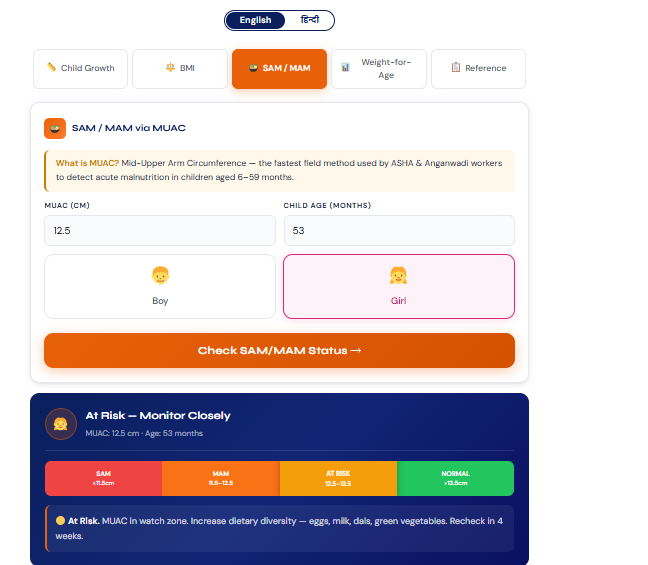
The Poshan Calculator includes a dedicated SAM/MAM screening tab using the MUAC method — the same method used by ASHA and Anganwadi workers in the field.
What is SAM (Severe Acute Malnutrition)?
SAM is diagnosed when a child’s Mid-Upper Arm Circumference (MUAC) is below 11.5 cm, or their weight-for-height z-score is below -3 SD.
Children with SAM are at immediate risk of death without medical intervention. They require inpatient care at a Nutrition Rehabilitation Centre (NRC).
- MUAC threshold: Below 11.5 cm
- WFH threshold: Below -3 SD
- Hindi: गंभीर तीव्र कुपोषण (Gambhir Teevra Kuposan)
- Treatment: Ready-to-Use Therapeutic Food (RUTF), F-75 and F-100 therapeutic milk
- Where to go: Nearest NRC — ask your Anganwadi worker or call 104
What is MAM (Moderate Acute Malnutrition)?
MAM is diagnosed when MUAC is between 11.5 and 12.5 cm, or the WFH z-score is between -3 and -2 SD. MAM children are at high risk of deteriorating to SAM without intervention, but can typically be managed in community-based programmes without hospitalisation.
- MUAC threshold: 11.5 – 12.5 cm
- WFH threshold: -3 to -2 SD
- Hindi: मध्यम तीव्र कुपोषण (Madhyam Teevra Kuposan)
- Treatment: Supplementary nutrition programme (SNP) at Anganwadi centre
- Monitoring: MUAC every 2 weeks until recovery to above 12.5 cm
How to Measure MUAC
1. Position the child: Have the child stand upright or sit straight. Use the left arm.
2. Find the midpoint: Find the midpoint between the tip of the shoulder (acromion) and the tip of the elbow (olecranon). Mark this point with a soft pencil.
3. Apply the MUAC tape: Wrap the MUAC tape around the arm at the marked midpoint. The arm must be relaxed at the side.
4. Read the result: Read the measurement where the tape ends meet. Record to the nearest 0.1 cm.
5. Classify the result: Below 11.5 cm = SAM. 11.5–12.5 cm = MAM. 12.5–13.5 cm = At risk. Above 13.5 cm = Normal.
SAM/MAM Quick Reference
| MUAC Reading | Status | Colour Code | Action |
|---|---|---|---|
| Below 11.5 cm | SAM | Red | NRC referral immediately |
| 11.5 – 12.5 cm | MAM | Orange | Enroll in Anganwadi SNP |
| 12.5 – 13.5 cm | At Risk | Yellow | Monitor; improve diet |
| Above 13.5 cm | Normal | Green | Continue healthy feeding |
⚠️ Important: SAM is a medical emergency. If your child’s MUAC is below 11.5 cm, do not wait. Go to the nearest government hospital or Nutrition Rehabilitation Centre (NRC) immediately. Call helpline 1800-180-1104 for guidance.
How to Use the Poshan Calculator — Step-by-Step Guide
The Poshan Calculator has five tabs: Child Growth, BMI, SAM/MAM, Weight-for-Age, and Reference. Each takes less than 60 seconds to complete. No account, no download, no government credentials required.
Tab 1: Child Growth Assessment (Most Used)
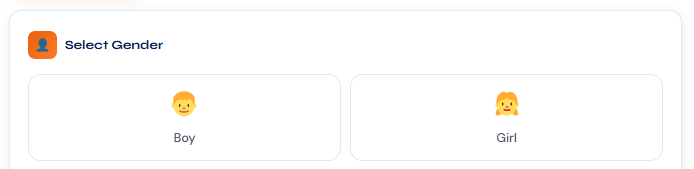
Select gender: Click Boy (लड़का) or Girl (लड़की). WHO growth standards differ by gender — this step is essential for accurate results.
Enter date of birth: The calculator computes the exact age in months from the date of birth. This is more accurate than entering age manually. Supported range: 0–60 months (birth to 5 years).

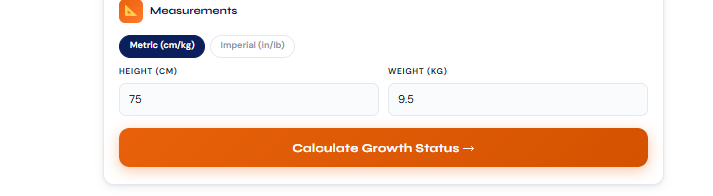
Choose unit system: Select Metric (cm/kg) for standard Indian measurements, or Imperial (inches/pounds) if needed.
Enter height and weight: Use a calibrated height board and infant weighing scale for the most accurate readings. Enter to one decimal place.
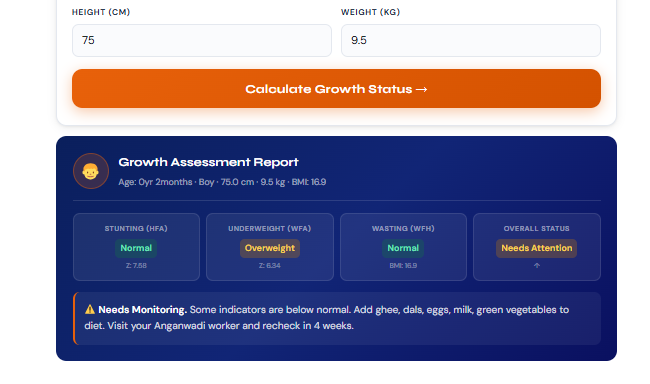
Click Calculate: Instantly receive z-scores and colour-coded classification for stunting (HFA), underweight (WFA), and wasting (BMI-for-Age), plus an overall status and personalised advice.
Tab 2: BMI Calculator
- Enter height and weight: Supports both metric and imperial units.
- Enter age and gender: Required for BMI-for-Age calculation in children.
- View result: BMI value, visual meter, WHO category, and dietary advice tailored to the Indian context.
Tab 3: SAM/MAM Screening (MUAC)
- Measure MUAC: Use a standard MUAC tape on the child’s left arm at the midpoint.
- Enter MUAC, age (months), and gender: Validated for children aged 6–59 months.
- View status: Colour-coded SAM/MAM/At Risk/Normal scale with recommended next steps.
Tab 4: Weight-for-Age (WFA)
- Select gender and enter age in months: Supported range: 0–60 months.
- Enter current weight: Enter in kilograms to one decimal place.
- View WFA z-score: Compare the child’s weight to the WHO median for their exact age group.
Tips for Accurate Results
• Always weigh children without shoes or heavy clothing
• Measure height with the child standing straight against a wall (for children above 2 years)
• For infants under 2, measure length lying flat (recumbent length)
• Record measurements to the nearest 0.1 cm and 0.1 kg
• Re-take measurements if results seem unusual — measurement error is common in field settings
Who Should Use the Poshan Calculator?
The Poshan Calculator is designed for anyone involved in child health and nutrition in India — from frontline health workers to urban parents. No technical background is needed.
Anganwadi Workers
Anganwadi workers (AWWs) under the ICDS scheme are responsible for monthly growth monitoring of all children aged 0–6 years in their catchment area.
The Poshan Calculator gives AWWs an instant digital verification tool — check a child’s z-score classification in the field without referring to printed WHO charts.
- Use case: Monthly weighing and height recording sessions
- Most useful tab: Child Growth + Weight-for-Age
- Benefit: Identifies SAM/MAM children for NRC referral before the monthly report is due
ASHA Workers
ASHA (Accredited Social Health Activist) workers conduct community-level health assessments and home visits. The SAM/MAM MUAC tab is specifically designed for the kind of rapid field screening that ASHA workers perform daily.
- Use case: Community MUAC screening drives and home visits
- Most useful tab: SAM/MAM (MUAC)
- Benefit: Results in plain language with clear action steps — SAM, MAM, At Risk, or Normal
Parents and Caregivers
Parents do not need any training to use the Poshan Calculator. Simply enter your child’s details and get an immediate understanding of whether their growth is on track. The bilingual Hindi-English interface makes results accessible to parents across India.
- Use case: Monthly home monitoring between Anganwadi visits
- Most useful tab: Child Growth + BMI
- Benefit: Early detection of mild underweight before it becomes moderate or severe
Healthcare Professionals and NGOs
Doctors, nurses, nutritionists, and NGO health workers can use the calculator for rapid field assessments, training demonstrations, and community health camps. The Reference tab provides a complete WHO z-score table and key terms in both English and Hindi.
| User | Primary Tab | Key Benefit |
|---|---|---|
| Anganwadi Worker | Child Growth + WFA | Monthly reporting, NRC identification |
| ASHA Worker | SAM/MAM (MUAC) | Rapid field screening in 60 seconds |
| Parent / Caregiver | Child Growth + BMI | Home monitoring, early detection |
| CDPO / Supervisor | Reference tab | Training, z-score validation |
| NGO / Health Camp | All tabs | Comprehensive screening |
| Pregnant Woman | BMI tab | Pre-pregnancy weight status |
WHO Growth Standards and Z-Scores — How They Work
All calculations in the Poshan Calculator are based on the WHO Child Growth Standards published in 2006. These standards describe how children should grow when their needs for good nutrition, health care, and a safe environment are met.
They are used as the universal reference for child growth monitoring worldwide.
What is a Z-Score?
A z-score (also called a standard deviation score) tells you how far a child’s measurement is from the average for healthy children of the same age and gender.
A z-score of 0 means the child is exactly at the median. A z-score of -2 means the child’s measurement is 2 standard deviations below the average, which is the threshold for classifying malnutrition.
Z-score in plain language: Think of z-scores like a class rank. If 100 healthy children of the same age were lined up by height, a child with a z-score of -2 would be shorter than 97.5 of them. That’s where we draw the line for ‘moderate stunting’.
Complete WHO Z-Score Classification Reference
| Z-Score | HFA (Stunting) | WFA (Underweight) | WFH (Wasting) | BMI-for-Age |
|---|---|---|---|---|
| Above +3 SD | Unusually tall | Obese | Obese | Obese |
| +2 to +3 SD | Tall | Overweight | Overweight | Overweight |
| -1 to +2 SD | Normal | Normal | Normal | Normal |
| -2 to -1 SD | Mildly stunted | Mildly underweight | Mildly wasted | Mildly thin |
| -3 to -2 SD | Moderately stunted | Moderately underweight | Moderately wasted | Moderately thin |
| Below -3 SD | Severely stunted | Severely underweight | SAM | Severely thin |
📌 Note: A child can be stunted but not wasted, or wasted but not stunted. Checking only one indicator gives an incomplete picture. The Poshan Calculator checks all indicators simultaneously to give a complete assessment.
Height-Weight Chart for Indian Children — WHO Reference
The table below shows the WHO median height and weight values for Indian boys and girls from birth to 5 years. Use these as reference benchmarks alongside the Poshan Calculator results. For downloadable PDF charts, visit the official WHO website or poshantracker.in.
WHO Median Weight-for-Age — Boys (Birth to 60 Months)
| Age | WHO Median Wt (kg) | Normal Range | Mild UW Below | SAM Below |
|---|---|---|---|---|
| Birth (0m) | 3.35 kg | 2.5 – 4.4 kg | 2.5 kg | 1.7 kg |
| 3 months | 6.37 kg | 4.9 – 8.2 kg | 4.9 kg | 3.3 kg |
| 6 months | 7.93 kg | 6.0 – 10.1 kg | 6.0 kg | 4.0 kg |
| 12 months | 10.2 kg | 7.7 – 13.2 kg | 7.7 kg | 5.1 kg |
| 18 months | 11.5 kg | 8.7 – 15.0 kg | 8.7 kg | 5.7 kg |
| 24 months | 12.3 kg | 9.4 – 16.1 kg | 9.4 kg | 6.1 kg |
| 36 months | 14.3 kg | 10.9 – 18.8 kg | 10.9 kg | 7.1 kg |
| 48 months | 16.3 kg | 12.4 – 21.5 kg | 12.4 kg | 8.1 kg |
| 60 months | 18.3 kg | 13.8 – 24.2 kg | 13.8 kg | 9.0 kg |
WHO Median Weight-for-Age — Girls (Birth to 60 Months)
| Age | WHO Median Wt (kg) | Normal Range | Mild UW Below | SAM Below |
|---|---|---|---|---|
| Birth (0m) | 3.23 kg | 2.4 – 4.2 kg | 2.4 kg | 1.6 kg |
| 3 months | 5.82 kg | 4.4 – 7.5 kg | 4.4 kg | 2.9 kg |
| 6 months | 7.30 kg | 5.5 – 9.4 kg | 5.5 kg | 3.6 kg |
| 12 months | 9.53 kg | 7.1 – 12.4 kg | 7.1 kg | 4.6 kg |
| 18 months | 10.8 kg | 8.1 – 14.1 kg | 8.1 kg | 5.3 kg |
| 24 months | 11.7 kg | 8.8 – 15.4 kg | 8.8 kg | 5.7 kg |
| 36 months | 13.9 kg | 10.5 – 18.5 kg | 10.5 kg | 6.8 kg |
| 48 months | 15.9 kg | 12.0 – 21.4 kg | 12.0 kg | 7.8 kg |
| 60 months | 18.2 kg | 13.7 – 24.4 kg | 13.7 kg | 8.9 kg |
📌 Note: These are WHO international medians. Indian children may fall slightly below these values on average due to population differences. However, WHO standards are still the recommended reference for clinical and programmatic use in India, as mandated by the Ministry of Health and Family Welfare.
Poshan Abhiyaan — India’s National Nutrition Mission
The Poshan Calculator supports the goals of Poshan Abhiyaan (पोषण अभियान), India’s flagship National Nutrition Mission launched by the Government of India in 2018. The mission aims to reduce stunting, wasting, and underweight among children under 5 years, and anaemia among children, adolescent girls, and pregnant women.
Key Government Nutrition Schemes Supported
| Scheme | Beneficiary | What It Provides |
|---|---|---|
| Poshan Abhiyaan | Children 0–6, pregnant/lactating women | Nutrition tracking, monthly growth monitoring, awareness drives |
| ICDS (Anganwadi Services) | Children 0–6, pregnant/lactating women | Supplementary nutrition (SNP), pre-school education, health check-ups |
| PM Matru Vandana Yojana | Pregnant women (1st live birth) | ₹5,000 maternity benefit in 3 instalments |
| NRC (Nutrition Rehab Centres) | SAM children under 5 | Inpatient therapeutic feeding and medical care |
| MAA Programme | Mothers and newborns | Breastfeeding counselling and support |
| SABLA / Kishori Shakti Yojana | Adolescent girls 11–18 years | Nutritional supplements, health education |
Helplines and Emergency Contacts
| Service | Number |
|---|---|
| Poshan / ICDS Helpline (Toll Free) | 1800-180-1104 |
| Child Helpline (Childline India, 24×7) | 1098 |
| Health Helpline / NRC Referral | 104 |
| MoWCD Headquarters, New Delhi | 011-23388465 |
| National Nutrition Mission (Poshan) | 1800-180-1104 |

FAQs About the Poshan Calculator
What is the Poshan Calculator, and what does it calculate?
The Poshan Calculator is a free online tool that measures a child’s nutritional status using the WHO Child Growth Standards. It calculates weight-for-age (WFA) z-scores to detect underweight, height-for-age (HFA) z-scores to detect stunting, weight-for-height (WFH)/BMI-for-age to detect wasting, MUAC-based SAM/MAM classification, and standard BMI for adults. Results include a z-score value, a colour-coded classification (normal/mild/moderate/severe), and personalised advice in both English and Hindi.
Is the Poshan Calculator the same as the Poshan Tracker app?
No. The Poshan Calculator is a free, open-access tool that anyone can use without a login to get instant child growth assessments. The Poshan Tracker app (poshantracker.in) is the official government system used by Anganwadi workers and ICDS staff to record and submit beneficiary data — it requires a government-issued login. Think of the Poshan Calculator as your reference tool and the Poshan Tracker as the official data entry system.
What age range does the Poshan Calculator support?
The Child Growth tab (HFA, WFA, BMI-for-age) supports children from birth to 60 months (0–5 years). The SAM/MAM MUAC screening tab is validated for children aged 6 to 59 months, in line with WHO and UNICEF guidelines. The Weight-for-Age tab supports 0–60 months. The BMI calculator supports ages 5 and above for children, and all ages for adults.
What is the difference between SAM and MAM?
SAM stands for Severe Acute Malnutrition — diagnosed when MUAC is below 11.5 cm or weight-for-height is below -3 SD. SAM children require immediate hospitalisation at a Nutrition Rehabilitation Centre (NRC). MAM stands for Moderate Acute Malnutrition — diagnosed when MUAC is between 11.5 and 12.5 cm. MAM children can be managed through community-based supplementary nutrition programmes at their local Anganwadi centre.
How accurate is the Poshan Calculator?
The calculator uses the official WHO Child Growth Standards z-score reference tables — the same tables used by the Government of India, UNICEF, and WHO globally. The accuracy of the results depends on the accuracy of the measurements entered. Always use a calibrated scale and height board, and measure to the nearest 0.1 cm and 0.1 kg. This is a screening tool — for diagnosis and medical decisions, always consult a qualified healthcare provider.
What is weight-for-age, and why does it matter?
Weight-for-Age (WFA) is one of the three core WHO growth indicators used in India’s ICDS programme. It compares a child’s weight to the expected weight for a healthy child of the same age and gender. WFA detects both chronic undernutrition (the combined effect of stunting and wasting) and acute undernutrition. A WFA z-score below -2 SD is classified as underweight, and below -3 SD as severe underweight — both requiring action through the Anganwadi supplementary nutrition programme.
Can parents use this calculator at home?
Yes, absolutely. The Poshan Calculator requires no technical knowledge, no login, and no download. Enter your child’s gender, date of birth, height, and weight, and the calculator provides instant results with plain-language explanations and advice. The bilingual Hindi-English interface makes it accessible for parents across India. For the most accurate results, use the calculator monthly to track your child’s growth over time.
What should I do if my child’s result shows moderate or severe malnutrition?
If the calculator shows Moderate Stunting, Moderate Underweight, MAM, or any ‘Severe’ classification: visit your nearest Anganwadi centre and inform the Anganwadi worker immediately. For SAM (Severe Acute Malnutrition) — this is a medical emergency. Go directly to the nearest Nutrition Rehabilitation Centre (NRC) or government hospital. You can call the Poshan helpline at 1800-180-1104 (toll-free) or the health helpline at 104 for guidance and referral.