The Poshan Calculator BMI is a simple and accurate tool that helps you calculate Body Mass Index (BMI) for both children and adults in seconds. It is designed to give a quick understanding of whether your body weight is healthy according to your height.
BMI Calculator
This tool uses standard BMI formulas and follows WHO-based health guidelines, making it useful for basic health awareness and nutritional screening.
You can use this calculator to:
- Check the adult BMI status, such as underweight, normal, overweight, or obese
- Get a basic child BMI reading with guidance based on WHO BMI-for-age standards
- Understand your overall health and nutrition condition instantly
The goal of this tool is to make health monitoring simple, fast, and accessible for everyone without any medical complexity.
What is BMI in the Poshan Calculator?
BMI (Body Mass Index) in the Poshan Calculator is a simple health measurement that shows whether a person’s weight is appropriate for their height. It is widely used as a basic screening tool to understand nutritional and health status in both children and adults.
BMI does not measure body fat directly, but it provides a strong indication of whether someone is underweight, normal weight, overweight, or obese using standard medical formulas.
What Does BMI Measure?
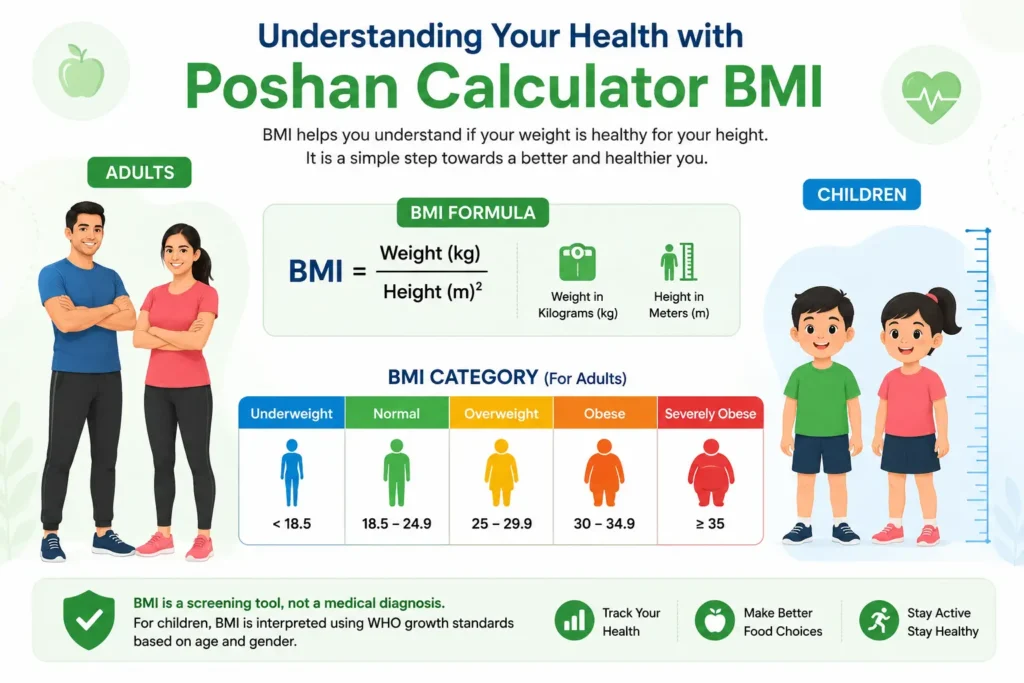
It is calculated using a simple formula:
👉 BMI = Weight (kg) ÷ Height (m²)
This value helps estimate whether the body weight is healthy for a given height. It is a quick screening indicator, not a diagnostic test.
Why BMI is Important for Health
BMI is important because it helps identify early signs of malnutrition or excess weight.
A healthy BMI range can indicate:
- Good nutritional balance
- Lower risk of lifestyle diseases
- Proper growth in children
Very low or high BMI may suggest:
- Underweight issues or malnutrition
- Overweight or obesity risks
- Need for dietary or lifestyle changes.
How BMI is Used in Poshan & WHO Programs
In Poshan and WHO-based health programs, BMI is used as a basic screening tool for population health monitoring.
For adults, it helps classify general weight status. For children, BMI is interpreted using the WHO BMI-for-age growth standards, which take age and gender into account for accurate assessment.
This makes BMI an important part of nutrition tracking, child growth monitoring, and public health programs worldwide.
BMI Calculator for Adults (India Guidelines)
The Poshan Calculator BMI for Adults helps you quickly determine whether your body weight is healthy for your height. It is based on the standard BMI formula and is commonly used in health checkups, fitness tracking, and basic nutrition assessment in India.
For adults (age 18+), BMI is a widely accepted indicator to classify underweight, normal weight, overweight, and obesity levels.
Adult BMI Formula Explained
Adult BMI is calculated using a simple formula:
👉 BMI = Weight (kg) ÷ Height (m²)
Steps:
- Measure your weight in kilograms.
- Measure your height in meters.
- Apply the formula to calculate your BMI.
This number helps estimate whether your body weight is suitable for your height.
BMI Categories for Adults
Adult BMI is classified into standard health ranges:
- Below 18.5 → Underweight
- 18.5 – 24.9 → Normal weight
- 25 – 29.9 → Overweight
- 30 and above → Obesity
These categories are used globally as a basic reference for health screening.
What Your Adult BMI Result Means
Your BMI result gives an overall idea of your health and body condition:
- Underweight: May indicate low nutrition or health issues
- Normal weight: Indicates a healthy balance of height and weight
- Overweight: Suggests extra body weight that may affect health
- Obese: Higher risk of lifestyle diseases like diabetes and heart problems
BMI is not a medical diagnosis, but it is a useful starting point for understanding your health status and taking preventive action.
Child BMI Calculator (WHO BMI-for-Age Explained)
The Child BMI Calculator in Poshan Calculator is designed to assess a child’s growth and nutritional status using WHO BMI-for-age standards. Unlike adults, children cannot be evaluated using simple BMI ranges because their bodies are still growing.
This is why child BMI is interpreted differently, using age- and gender-based growth charts to provide accurate health information.
Why BMI for Children is Different
Children are constantly growing in height, weight, and body composition, so a fixed BMI range (as in adults) does not yield an accurate result.
That’s why:
- A child’s BMI must be compared with age-specific growth standards.
- Boys and girls are assessed separately using the WHO growth charts.
- Growth patterns change rapidly during development.
This makes child BMI a growth monitoring indicator, not just a weight check.
What is BMI-for-Age (WHO Standard)
BMI-for-age is a WHO-developed method that compares a child’s BMI with a reference population of the same age and gender.
It helps identify:
- Underweight or wasting risk
- Normal growth pattern
- Overweight or obesity risk
Instead of a single number, results are interpreted using percentiles or Z-scores, which give a more accurate picture of child development.
How Poshan Uses BMI for Child Growth Monitoring
The Poshan Calculator uses BMI as an initial screening step and aligns it with WHO-based principles for interpreting child growth.
It helps in:
- Early detection of malnutrition risks
- Understanding growth trends in children
- Supporting parents and health workers in basic nutrition awareness
For detailed analysis, BMI is combined with other indicators like height-for-age and weight-for-age, making child growth monitoring more reliable and meaningful.
BMI Categories Chart (India & WHO Standards)
The BMI Categories Chart helps you quickly understand what your BMI result means based on standard WHO and India-based classifications.
It converts your BMI number into a clear health status, such as underweight, normal, overweight, or obese. This section is useful for both quick interpretation and health awareness after using the Poshan BMI Calculator.
📊 BMI Classification Table (Adults – WHO/India Standard)
| BMI Range | Category | Health Meaning |
| Below 18.5 | Underweight | Possible low nutrition or underweight condition |
| 18.5 – 24.9 | Normal Weight | Healthy weight range |
| 25.0 – 29.9 | Overweight | Increased risk of health issues |
| 30.0 and above | Obesity | High risk of lifestyle diseases |
Adult BMI Classification Table
For adults (18+ years), BMI is interpreted using fixed ranges. These ranges help determine whether a person’s body weight is healthy relative to their height.
- A normal BMI range (18.5–24.9) indicates a healthy weight.
- A BMI below 18.5 suggests underweight or low body mass.
- A BMI above 25 may indicate excess weight or obesity risk.
These categories are widely used in health checkups, fitness tracking, and medical screening.
Child BMI Interpretation (Z-Score Basics)
For children, BMI is not interpreted using fixed ranges. Instead, it is measured using WHO BMI-for-age Z-scores, which compare a child’s BMI with that of others of the same age and gender.
Key interpretation levels include:
- Below -2 Z-score → Underweight or possible wasting
- -2 to +1 Z-score → Normal growth range
- Above +1 Z-score → Risk of overweight
- Above +2 Z-score → Obesity risk
This method ensures that children are evaluated based on growth patterns rather than adult-like fixed values, making it more accurate for monitoring child nutrition and development.
How to Use This BMI Calculator
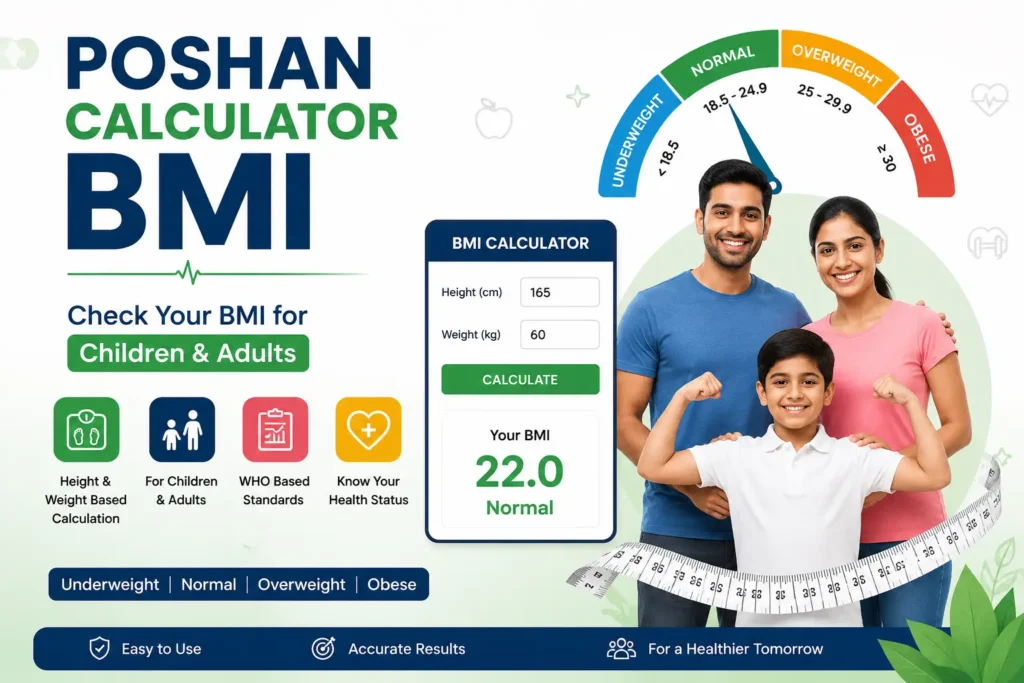
The Poshan Calculator BMI tool is designed to be simple and user-friendly, allowing you to calculate your Body Mass Index (BMI) in just a few seconds. You only need basic information like age, height, and weight to get your result instantly.
This section explains how to correctly use the calculator for both adults and children.
Steps to Calculate BMI
Follow these simple steps to calculate your BMI:
- Enter your age.
- Select your gender.
- Choose your height unit (cm or feet/inches).
- Enter your height accurately.
- Enter your weight in kilograms.
- Click on the “Calculate BMI” button.
Your result will appear instantly with your BMI value and category (underweight, normal, overweight, or obese).
CM vs Feet/Inches Option Explained
The calculator allows you to enter height in two different formats:
- Centimetres (CM): Commonly used in medical and official records in India
- Feet & Inches: Useful for everyday personal measurement
Both options give the same accurate result because the tool automatically converts your height into meters for BMI calculation. 👉 This flexibility makes the tool easy to use for everyone, regardless of measurement preference.
Tips for Accurate Results
To get the most accurate BMI result, keep these points in mind:
- Use correct and recent weight measurements.
- Measure height without shoes for accuracy.
- Avoid estimating values (use actual numbers).
- Ensure you enter units correctly (kg, cm, or feet/inches)
- For children, always interpret BMI using the WHO BMI-for-age standards.
Following these tips ensures your results more accurately reflect your true health status.
What Your BMI Result Means (Action Guide)
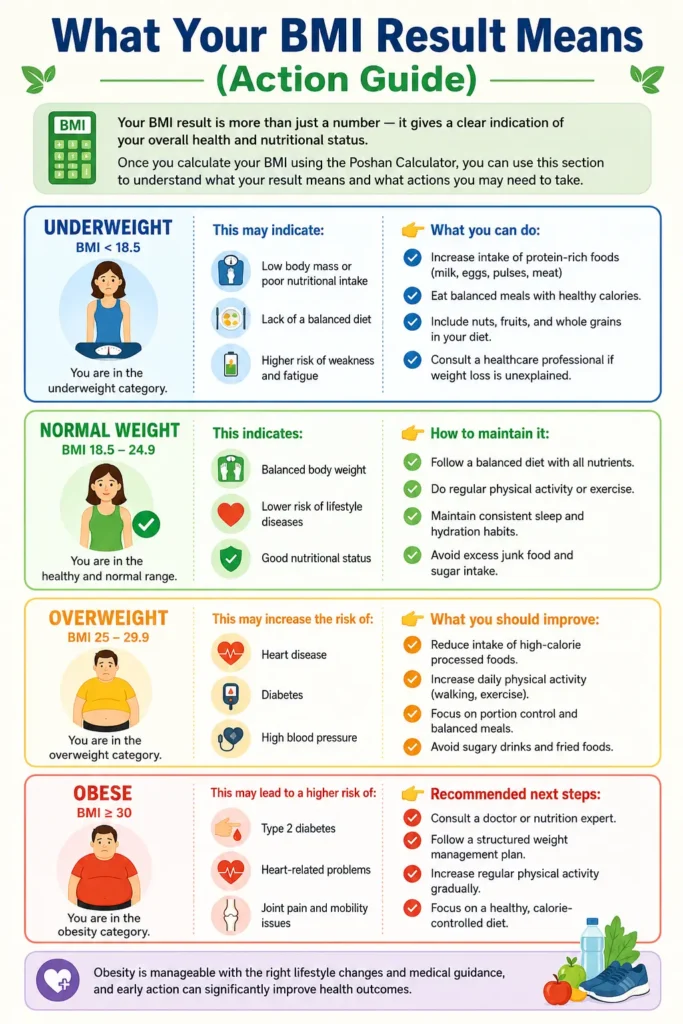
Your BMI result is more than just a number — it gives a clear indication of your overall health and nutritional status.
Once you calculate your BMI using the Poshan Calculator, you can use this section to understand what your result means and what actions you may need to take.
Underweight – What to Do
If your BMI is below 18.5, it means you are in the underweight category.
This may indicate:
- Low body mass or poor nutritional intake
- Lack of a balanced diet
- Higher risk of weakness and fatigue
👉 What you can do:
- Increase intake of protein-rich foods (milk, eggs, pulses, meat)
- Eat balanced meals with healthy calories.
- Include nuts, fruits, and whole grains in your diet.
- Consult a healthcare professional if weight loss is unexplained.
Normal Weight – How to Maintain
A BMI between 18.5 and 24.9 is considered healthy and normal.
This indicates:
- Balanced body weight
- Lower risk of lifestyle diseases
- Good nutritional status
👉 How to maintain it:
- Follow a balanced diet with all nutrients.
- Do regular physical activity or exercise
- Maintain consistent sleep and hydration habits.
- Avoid excess junk food and sugar intake.
Overweight – What to Improve
A BMI between 25 and 29.9 is classified as overweight. This may increase the risk of:
- Heart disease
- Diabetes
- High blood pressure
👉 What you should improve:
- Reduce intake of high-calorie processed foods.
- Increase daily physical activity (walking, exercise)
- Focus on portion control and balanced meals.
- Avoid sugary drinks and fried foods.
Obese – Health Risks & Next Steps
A BMI of 30 or above falls into the obesity category. This condition may lead to a higher risk of:
- Type 2 diabetes
- Heart-related problems
- Joint pain and mobility issues
👉 Recommended next steps:
- Consult a doctor or nutrition expert.
- Follow a structured weight management plan.
- Increase regular physical activity gradually.
- Focus on a healthy, calorie-controlled diet.
Obesity is manageable with the right lifestyle changes and medical guidance, and early action can significantly improve health outcomes.
BMI vs Other Poshan Indicators
The Poshan Calculator BMI is an important health indicator, but it is not the only method used to assess nutrition and growth status, especially in children.
In public health and Poshan monitoring systems, BMI is often used alongside other key indicators to get a more complete understanding of a person’s nutritional condition.
BMI vs Weight-for-Age
BMI and Weight-for-Age both relate to body weight, but they measure different things:
- BMI compares weight with height to assess body proportion.
- Weight-for-Age compares a child’s weight with their age group.
👉 Key difference:
- BMI is more useful for identifying overall body balance
- Weight-for-age is more commonly used for basic child nutrition screening.
Together, they help identify underweight and growth-related issues more accurately.
BMI vs Height-for-Age (Stunting)
Height-for-Age is a key indicator of long-term growth and development in children.
- It shows whether a child is growing to their expected height for their age.
- Low height-for-age is called stunting.
👉 Difference from BMI:
- BMI reflects the current body weight status
- Height-for-age reflects long-term growth deficiency.
A child may have a normal BMI but still be stunted due to chronic malnutrition.
BMI vs MUAC (SAM/MAM Detection)
MUAC (Mid-Upper Arm Circumference) is another important indicator used in malnutrition screening programs (SAM/MAM detection).
- MUAC measures the arm circumference to detect acute malnutrition
- It is widely used in field surveys and emergency nutrition programs.
👉 Key difference:
- BMI requires height and weight calculation
- MUAC is a quick field measurement tool
BMI gives a general overview, while MUAC is more focused on detecting severe acute malnutrition (SAM) and moderate acute malnutrition (MAM) in children.
Together, BMI, Weight-for-Age, Height-for-Age, and MUAC form a comprehensive system for assessing nutrition, growth, and health status in line with Poshan and WHO guidelines.
Limitations of BMI (Important for Trust)
While BMI (Body Mass Index) is a widely used and simple method for assessing weight status, it is not a perfect measure. The Poshan Calculator BMI tool provides a quick health overview, but it should always be understood with its limitations in mind.
BMI is mainly a screening tool, not a diagnostic test, and it may not fully reflect a person’s actual body composition or health condition.
When BMI May Not Be Accurate
BMI may not give a fully accurate picture in certain situations, such as:
- People with high muscle mass (athletes or bodybuilders)
- Individuals with very low or very high body frame size
- Cases where fat distribution is uneven in the body
- During pregnancy or growth phases in children and teenagers
👉 In these cases, BMI may classify a person incorrectly as overweight or normal even when body composition differs. That is why BMI should always be considered as a general health indicator, not a final medical conclusion.
Why Children Need WHO Growth Charts
For children, BMI alone is not enough, as their bodies are continually growing in height, weight, and developmental patterns. That’s why WHO growth charts and BMI-for-age standards are used instead.
These charts are important because they:
- Compare a child’s growth with that of other children of the same age and gender.
- Provide more accurate interpretation using Z-scores or percentiles.
- Help detect early signs of underweight, stunting, or obesity.
👉 In child health monitoring, WHO growth charts are essential for understanding true nutritional and developmental status, beyond just a single BMI value.
FAQs – Poshan Calculator BMI
This section answers the most common questions about BMI, its meaning, and how the Poshan Calculator works. These FAQs help users better understand their results and improve health awareness and decision-making.
What is a good BMI for adults in India?
A good or healthy BMI for adults in India is generally between 18.5 and 24.9. This range indicates that your body weight is appropriate for your height and is associated with a lower risk of lifestyle-related health problems. However, BMI should always be considered alongside diet, physical activity, and overall health.
Can BMI detect malnutrition in children?
BMI can give a basic indication of nutritional status, but it is not enough on its own to detect malnutrition in children. For accurate assessment, children are evaluated using:
- BMI-for-age (WHO standards)
- Weight-for-age charts
- Height-for-age (stunting indicators)
- MUAC measurements
👉 These combined indicators help identify underweight, wasting, or stunting risks more accurately.
Is BMI different for boys and girls?
For adults, BMI calculation is the same for both males and females. However, for children, interpretation is different because:
- Boys and girls have different growth patterns.
- BMI is compared using the WHO gender-specific growth charts
👉 This ensures a more accurate evaluation of child development and nutrition status.
Should I use BMI daily?
No, you do not need to calculate BMI daily. BMI is a general health indicator, and it is usually enough to check it:
- Once a month
- Or during regular health checkups
👉 Frequent daily tracking is not necessary because body weight naturally fluctuates due to water, food intake, and other factors.
Is this Poshan BMI calculator accurate?
Yes, the Poshan Calculator BMI tool is accurate for standard BMI calculation as it uses the correct formula:
👉 BMI = Weight (kg) ÷ Height (m²)
However, it is important to understand that:
- It is a screening tool, not a medical diagnosis.
- For children, results should be interpreted using the WHO BMI-for-age standards.
👉 For complete analysis, it should be used along with other Poshan growth indicators and medical advice if needed.
Use the Full Poshan Calculator for Detailed Analysis
The BMI Calculator gives you a quick understanding of your basic health and weight status, but it is only one part of an overall nutrition assessment. For a more complete and accurate analysis of child and adult growth, you should use the full Poshan Calculator tools.
These tools help you understand deeper health indicators, such as growth patterns, malnutrition risk, and age-based developmental status.
👉 Use the following advanced tools for detailed analysis:
- Child Growth Tool → to check height-for-age, weight-for-age, and overall child development status
- SAM/MAM Tool → to identify severe and moderate acute malnutrition risk (MUAC-based screening)
- Weight-for-Age Tool → to assess whether a child’s weight is appropriate for their age group
Using these tools alongside BMI can provide a comprehensive Poshan-based health evaluation that is more reliable than BMI alone. 👉 For best results, always combine BMI + growth indicators for a full understanding of nutrition and health status.
Conclusion
The Poshan Calculator BMI is a simple, effective tool for understanding your Body Mass Index (BMI) for both children and adults. It helps you quickly identify whether your weight is below, within, or above the healthy range, based on WHO guidelines.
While BMI is not a medical diagnosis, it is a useful starting point for understanding your overall health and nutrition status. 👉 Use this calculator regularly to stay aware of your fitness, growth, and well-being, and make better health decisions for a healthier lifestyle.