
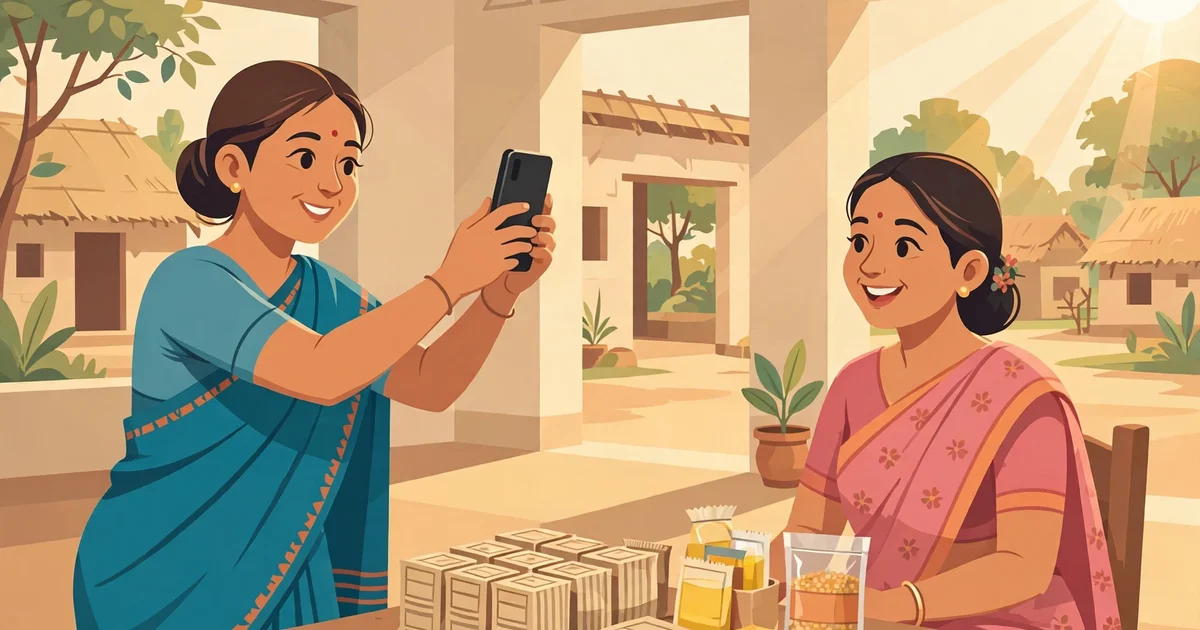
The simple answer is: FRS (Facial Recognition System) in Poshan Tracker is a face-matching feature that verifies a beneficiary’s identity with a live photo before Take-Home Ration (THR) is handed over. It makes sure the ration reaches the person it was meant for — no duplicates, no impersonation — using the same app Anganwadi workers already use every day.
If you collect Take-Home Ration from an Anganwadi centre, you may have been asked to look into a phone camera and blink — that is the FRS in Poshan Tracker at work, mandatory for THR verification since July 2025.
👉 While you are here, check your child’s growth status with the free Poshan Calculator — WHO z-scores in under a minute, no download needed.
In this article, you will understand:
- What FRS is and why it was added to Poshan Tracker for THR distribution
- The exact steps of one-time e-KYC and the monthly face-matching process
- How your data is protected, and what privacy concerns have been raised
- What to do if your face scan fails, and who is exempt
What Is the FRS Feature in the App?
FRS stands for Facial Recognition System. It is not a separate app — it is a module inside the Poshan Tracker application that Anganwadi Workers already use for beneficiary registration, growth monitoring, and service delivery. When THR (Take-Home Ration — monthly fortified food for pregnant women, lactating mothers, and young children) is distributed, the worker captures a live photo and the system matches it against the registered photo.
The goal is last-mile tracking: proving the ration reached the intended person, removing duplication and leakage.
Why Was FRS Introduced for THR Distribution?
Crores of THR packets move through nearly 14 lakh Anganwadi centres every month, and paper registers made verification hard. FRS was introduced to:
- Ensure the right beneficiary gets the ration — the photo taken at distribution must match the registered beneficiary.
- Remove duplicate and ghost entries from beneficiary lists.
- Strengthen accountability of field functionaries while protecting genuine beneficiaries’ entitlements.
After an August 2024 pilot in 6 States/UTs and a pan-India optional rollout in December 2024, face verification became mandatory from 1 July 2025.
For the government’s official explanation, see this Press Information Bureau release on FRS in Poshan Tracker.
How FRS in Poshan Tracker Works: The One-Time e-KYC
Every beneficiary goes through a one-time onboarding. Here are the steps:
- Photo capture at registration: the Anganwadi worker takes your photograph on the Poshan Tracker app.
- Aadhaar-based e-KYC: your identity is verified through the Aadhaar system. A mobile network is needed for this step — but only this once.
- Liveness check: you may be asked to blink or turn your head slightly, proving you are a real person in front of the camera, not a printed photo.
- Consent: because biometric details are sensitive, your specific consent is taken before face enrolment.
- Done. Monthly THR collection needs only a face match — no further OTP.
You can also finish e-KYC yourself through the app’s beneficiary module from home.
Key takeaway: e-KYC happens once; after that, each month is just a quick photo match.
How Face Matching Works at Every THR Distribution
At each monthly distribution, the worker captures a fresh photo in the app; the system matches it with your registered photo and records the distribution.
- No extra device needed: FRS runs on the same smartphone the worker already uses.
- Offline matching: after the one-time e-KYC, face matching works even without internet.
The Nominee Module: What If the Beneficiary Cannot Come?
If illness, travel, or a newborn keeps you from the centre, the Nominee Module lets a family member collect THR on your behalf.
- The nominee undergoes e-KYC only once, like a regular beneficiary.
- Face matching of the nominee happens every time THR is collected on the beneficiary’s behalf.
- The beneficiary herself can still collect her THR directly whenever she wishes.
FRS by the Numbers: How Many Beneficiaries Are Covered?
The government has published steady progress figures as onboarding continues across the country:
| As of | e-KYC and face capture completed | Share of eligible THR beneficiaries |
|---|---|---|
| 27 July 2025 | 3.55 crore of 4.95 crore | About 71.7% |
| 31 December 2025 | 4.51 crore of 4.73 crore | About 91.38% |
| December 2025 (THR via FRS) | 2.79 crore beneficiaries | About 52.68% of eligible |
👉 Key takeaway: Onboarding is nearly complete at over 91%, but only about half of eligible beneficiaries received THR through face matching in December 2025 — the system is still scaling up.
What Data Is Collected and How Is It Protected?
Understandably, beneficiaries ask: where does my photo go? According to the government’s statements in Parliament:
- Consent first: specific consent is taken before face enrolment through the Anganwadi worker.
- Not publicly accessible: the data is available only to authorised personnel, strictly for verification purposes.
- Role-based, logged, and monitored access: who views the data is controlled by their role, and access is recorded and watched to prevent misuse.
- No new hardware: because FRS is a software feature in the existing app, no separate biometric device database was created at centres.
Note: these are the government’s stated safeguards; observers continue to ask for more public detail on data retention and audits.
The Other Side: Privacy and Exclusion Concerns
Critics — including digital-rights observers and opposition leaders — have raised these concerns:
- Exclusion risk: critics argue that when a face scan fails — due to poor lighting, an old Aadhaar photo, or changes in appearance after childbirth — a beneficiary can be delayed or denied a ration that is her legal right under the National Food Security Act.
- Connectivity and app failures: field reports describe workers retrying scans many times in areas with weak networks, frustrating beneficiaries.
- Privacy questions: observers have asked for clearer public information on how long face data is stored, who can access it, and what independent audits exist.
- Legal scrutiny: the mandatory requirement has faced questions in the Karnataka High Court about proportionality and fallback options when technology fails.
The government points to the nominee module, offline matching, and gradual onboarding as answers to these concerns.
Key takeaway: The technology’s promise is real, but so are the concerns — knowing the fallback options protects your entitlement.
What to Do If Your Face Scan Fails
- Ask the worker to retry in better light — face the light source, remove veils or masks, and keep your face straight.
- Check your registration photo: if it is very old or unclear, ask for re-enrolment with a fresh photo.
- Use the nominee option if you cannot be present or your scan repeatedly fails.
- Complete e-KYC yourself through the beneficiary module from home if the centre’s network is the problem.
- Escalate to your supervisor or CDPO (Child Development Project Officer) if the problem persists.
FRS and Children: Who Is Exempt?
Children up to 6 years of age registered under Mission Saksham Anganwadi and Poshan 2.0 are not required to undergo e-KYC or FRS themselves. Instead, the mother, father, or any guardian can complete e-KYC and face verification and receive the child’s THR on their behalf.
👉 Parents: your own face verification covers your child’s ration — check your child’s growth too with the free Poshan Calculator.
FAQs
Is FRS mandatory for receiving Take-Home Ration?
Yes — face verification became mandatory from 1 July 2025 for THR beneficiaries, though children under 6 are exempt and guardians verify on their behalf.
Do I need internet for the face scan every month?
No. Mobile network is needed only once, for the initial e-KYC. Monthly face matching can be done in offline mode.
Can someone else collect my THR if I cannot go?
Yes, through the Nominee Module — your nominee completes a one-time e-KYC and verifies by face each time they collect on your behalf.
Is my photo shared publicly or with private companies?
According to the government, the data is not publicly accessible and is available only to authorised personnel for verification, with role-based, logged access.
Do I need a new app for FRS?
No. FRS is a built-in feature of the existing Poshan Tracker app used by Anganwadi workers — no separate download is needed.
Conclusion
FRS in Poshan Tracker is the government’s answer to a real problem: making sure monthly Take-Home Ration reaches the intended beneficiary and nobody else. The one-time e-KYC, offline monthly matching, and nominee module make it practical for field conditions, and coverage has crossed 91% of eligible beneficiaries. At the same time, the exclusion and privacy concerns raised by observers deserve honest attention — and every beneficiary should know the fallback options.
If your scan fails repeatedly, use the nominee module, ask for re-enrolment, and escalate to your supervisor — your ration is your right.
👉 Understand your child’s nutrition status today with the free Poshan Calculator — WHO-based z-scores, no download needed.