
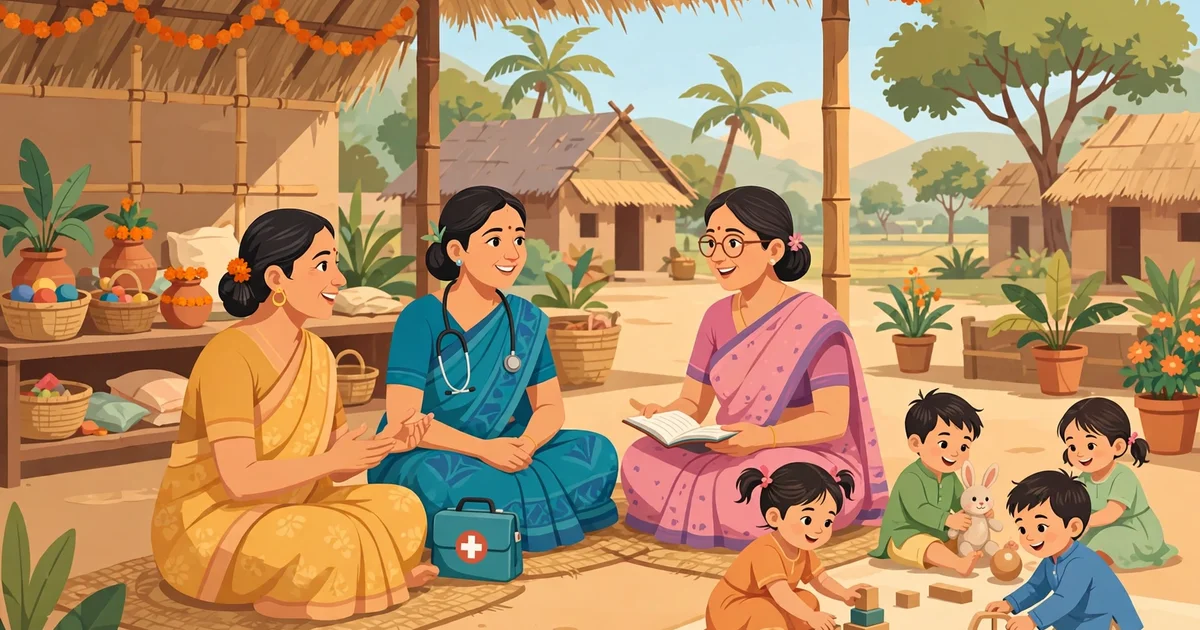
The simple answer is: an Anganwadi Management Committee is a small local group — parents, community women, the Anganwadi worker, and local officials — that watches over your village’s Anganwadi centre to make sure children get proper food, preschool learning, and health services. It is the community’s own watchdog and helper for the centre.
India has nearly 14 lakh Anganwadi centres, but a centre is only as good as the attention it gets. That is where Anganwadi Management Committees come in. These committees bring mothers, Self-Help Group members, teachers, and health workers together to review the centre’s functioning, check food quality, and solve problems before they grow.
👉 Parents: track your own child’s nutrition at home with the free Poshan Calculator — WHO z-scores in under a minute, no download needed.
In this article, you will understand:
- What an Anganwadi Management Committee is and why every centre needs one
- Who sits on the committee and how it is formed
- The five core responsibilities, from food quality to grievance redressal
- Best practices that make committees genuinely effective
What Is an Anganwadi Management Committee?
An Anganwadi Management Committee (AMC) is a village- or ward-level body constituted for each Anganwadi centre to strengthen community participation in its running. Instead of the centre being managed only by government staff, the committee gives local people — especially mothers and women — a formal role in planning, monitoring, and improving services.
The idea is simple: the people who use the centre every day are best placed to notice when food quality drops, when the building needs repair, or when a child stops coming. The committee turns that everyday observation into organised action.
Why Do Anganwadi Centres Need a Management Committee?
An Anganwadi worker handles preschool education, supplementary nutrition, growth monitoring, home visits, record-keeping, and Poshan Tracker data entry — an enormous workload. A committee shares the load and adds accountability:
- Community ownership: when mothers feel the centre is “ours”, enrolment and attendance improve.
- Transparency: regular review of food stocks, funds, and registers reduces leakage and builds trust.
- Faster problem-solving: a broken toilet or delayed ration gets fixed quicker when the whole village leadership is watching.
- Better convergence: the committee connects the Anganwadi with health (ASHA, ANM), education (school teachers), and panchayat resources.
Key takeaway: A committee turns a government centre into a community institution.
Who Sits on the Committee?
Composition varies by state, but a well-formed committee typically includes:
- Chairperson: often the woman supervisor of the area, or a panchayat/ward member — in Gujarat’s 2025 women-led model, all seven members are women with the woman supervisor as Chairperson.
- Member-Secretary: the Anganwadi worker, who convenes meetings and keeps records.
- Health representatives: the ASHA worker and sometimes the ANM (Auxiliary Nurse Midwife).
- Parents: two or more mothers of children enrolled at the centre.
- Community voices: a woman member of a local Self-Help Group (SHG) or NGO, and a woman teacher from the nearest government primary school.
The emphasis on women members is deliberate — mothers and women SHG members understand children’s needs first-hand. Gujarat’s decision to constitute women-led committees at every Anganwadi shows how seriously states are taking this.
How Anganwadi Management Committees Are Formed
Formation usually follows these steps, led by the CDPO (Child Development Project Officer):
- CDPO issues formation orders for committees at every Anganwadi centre in the project/block.
- Members are identified from the prescribed categories — supervisor, Anganwadi worker, ASHA, mothers, SHG member, and teacher.
- The first meeting is convened at the Anganwadi centre, where roles are explained and the Chairperson and Member-Secretary take charge.
- Records are created — a committee register noting members, meeting dates, decisions, and follow-up actions.
- The meeting calendar is fixed so reviews happen on schedule, not only when problems erupt.
Key takeaway: Formation is quick — what matters is whether meetings actually happen every cycle.
Core Role 1: Monitoring Services and Service Delivery
The committee’s first job is checking that entitled services actually reach beneficiaries: daily preschool activities, hot cooked meals for 3–6 year-olds, Take-Home Ration for pregnant women, lactating mothers and young children, growth monitoring, and home visits. Members can cross-check Poshan Tracker entries against what they see on the ground.
Core Role 2: Overseeing Infrastructure and Facilities
Committees examine the physical centre — the building, drinking water, toilets, kitchen, storage space, furniture, weighing scales, and Teaching Learning Material (TLM). Where gaps are found, the committee can raise them with the panchayat, the CDPO, or through community contribution (Jan Bhagidari) and CSR support.
Core Role 3: Ensuring Food Quality and Hygiene
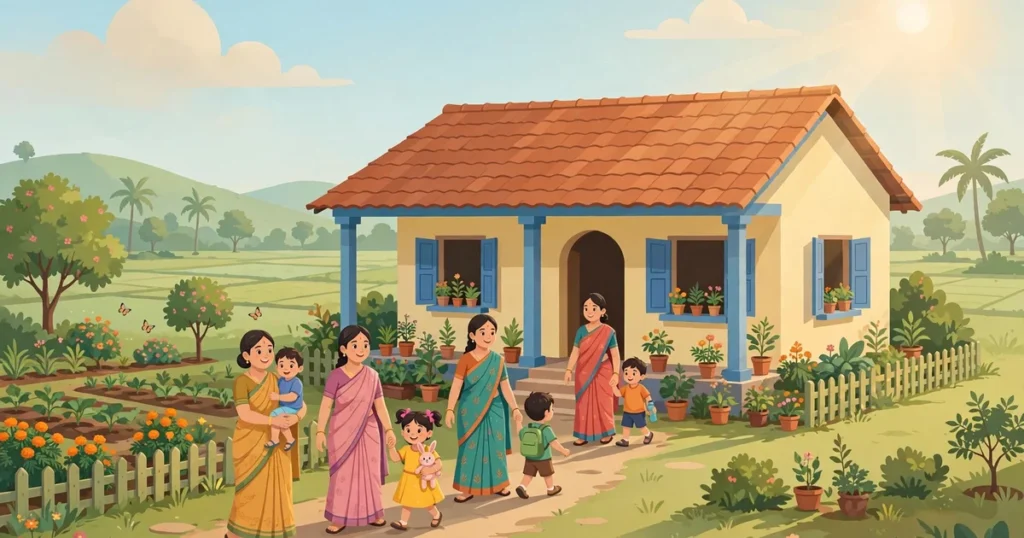
Nothing affects trust more than the food children eat. Committee members — especially mothers — can taste the meals, check THR packets for expiry and quality, verify that the kitchen is clean, and ensure safe drinking water. Any complaint about food quality should be recorded in the meeting minutes and escalated immediately.
👉 Worried about your child’s weight or height? Check growth status free on the Poshan Calculator before your next committee meeting.
Core Role 4: Community Mobilisation and Jan Bhagidari
Committees organise and support community events — Poshan Maah and Poshan Pakhwada activities, Godh Bharai ceremonies, Annaprashan Diwas, and parent meetings on breastfeeding and complementary feeding. They spread the word so no eligible family is left out of registration, and they encourage fathers and elders to support mothers’ nutrition.
Core Role 5: Grievance Redressal and Transparency
The committee is the first place a parent can raise a complaint — about denied rations, poor food, or a worker’s absence. Good committees record every grievance, set a deadline for resolution, and report back at the next meeting. Unresolved issues go up to the supervisor and CDPO. This local, visible process builds far more trust than a distant helpline alone.
How Often Should the Committee Meet?
Meeting frequency decides whether a committee is real or only on paper:
| Practice | Frequency | What gets reviewed |
|---|---|---|
| Minimum standard (e.g., Gujarat model) | Once every two months | Functioning, service quality, facilities, food hygiene |
| Best practice | Monthly | All of the above plus growth-monitoring data, grievances, and event planning |
👉 Key takeaway: Meet at least every two months — monthly is better, because children’s nutrition cannot wait a quarter.
Best Practices That Make Committees Work
- Keep written minutes of every meeting with action points and names — memory fades, registers do not.
- Rotate speaking turns so mothers and SHG members speak, not just officials.
- Visit unannounced occasionally — a surprise morning visit shows the real daily routine.
- Track one number: the count of malnourished children at the centre, reviewed every meeting until it falls.
- Celebrate improvements — publicly appreciate the worker when attendance or food quality rises.
- Link with the panchayat to unlock funds for repairs, water, and toilets.
Common Problems and How to Fix Them
- Meetings exist only on paper: fix by fixing a recurring date (e.g., the first Saturday) and informing all members by phone.
- Officials dominate, mothers stay silent: fix with a round-table format where every member reports one observation.
- Decisions are never followed up: fix by starting each meeting with a review of last meeting’s action points.
- No funds for repairs: fix by routing requests through the panchayat and exploring CSR and community contributions.
FAQs
What is the main purpose of an Anganwadi Management Committee?
To give the local community — especially mothers — a formal role in monitoring and improving the Anganwadi centre’s services, food quality, and facilities.
Who can become a committee member?
Typically the area supervisor, Anganwadi worker, ASHA, mothers of enrolled children, a woman SHG member, and a local woman teacher; exact composition varies by state.
How often should the committee meet?
At least once every two months, as in Gujarat’s model; monthly meetings are best practice for close monitoring.
Can the committee check food quality?
Yes — reviewing meals, THR packets, kitchen hygiene, and drinking water is one of its core responsibilities.
What if the committee’s complaints are ignored?
Record them in the meeting minutes and escalate to the supervisor and CDPO; unresolved grievances can go further up the ICDS chain.
Conclusion
Anganwadi Management Committees turn passive beneficiaries into active guardians of their children’s nutrition. When mothers, health workers, teachers, and local leaders sit together regularly — reviewing services, tasting the food, and tracking every malnourished child — centres improve visibly. If your village has a committee, join it; if it exists only on paper, ask your CDPO to activate it.
👉 Support your committee with facts: check your child’s WHO growth status on the free Poshan Calculator today.