
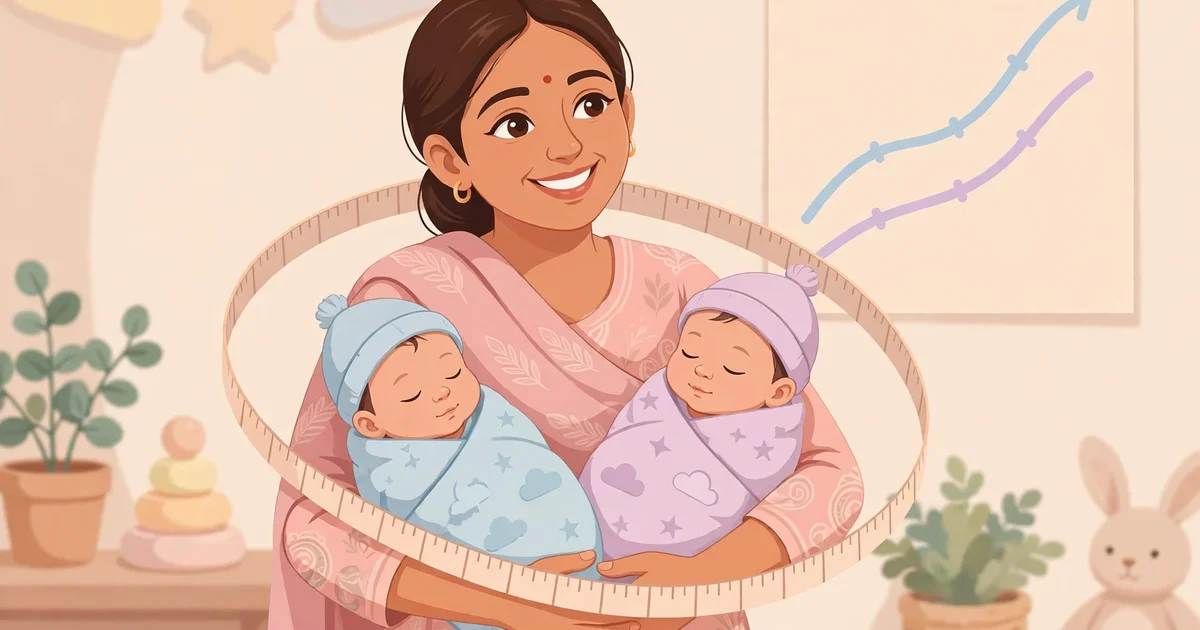
The simple answer is: yes — the Poshan Calculator for Twins works just as well as for single-born babies. You simply measure and enter each twin separately, and the tool checks each child against the same WHO (World Health Organization) growth standards. Twins are assessed as two individual children, never as a pair or an average.
Parents of twins often worry the calculator was “made for single babies.” Twins are frequently born smaller and earlier, and their first-year growth looks different — but growth standards describe how healthy children should grow, and they apply to every child. What matters is measuring each twin correctly and reading each result on its own.
👉 Try the free Poshan Calculator now — enter Twin A, note the result, then enter Twin B. Under two minutes for both.
This 2026 guide explains how to use the calculator for twins and triplets, how to read two sets of results, and when a gap between your twins needs a doctor’s attention.
In this article, you will understand:
- How the Poshan Calculator for Twins assesses each child individually
- The correct way to measure and enter data for each twin
- How to read and compare two growth results without confusion
- Warning signs in twins that need a doctor or Anganwadi worker
How Does the Poshan Calculator for Twins Work?
The Poshan Calculator for Twins is not a separate tool — it is the same free online calculator, used twice. For each twin, enter sex, birth date, weight, and length or height; the calculator compares them with WHO Child Growth Standards and shows a colour zone per child. Never average your twins’ measurements — averaging hides problems. Run it separately for Twin A and Twin B (and Twin C for triplets), and keep separate records.
Do Twins Grow Differently From Single-Born Babies?
Yes, especially at first. Twins are more likely to be born early and small, since two babies share the womb. In the first 6–12 months they often track slightly below singleton averages — usually normal, provided each twin follows their own steady curve. Most healthy twins converge toward standard curves by age 2. What matters is consistency per child: a flat or falling curve for either twin deserves attention, even if the other thrives. The WHO’s child growth standards apply to all children everywhere.
Can I Check Both Twins in One Session?
Yes — and you should. The calculator needs no login and saves nothing, so run it twice back to back: measure both twins, write down both sets of numbers, enter Twin A, note the result, repeat for Twin B. Label notes clearly — “Twin A / Twin B” — and use the same labels every month. Mixing up which result belongs to which twin is a common mistake that can mask a real problem for months.
Takeaway: One session, two separate checks, clearly labelled.
What Measurements Does the Calculator Need for Each Twin?
Each twin needs the same inputs as any child: sex (important for boy-girl twins), birth date, weight in kilograms without heavy clothing, and length or height — lying down under age 2, standing from age 2. For twins born before 37 weeks, use corrected age (from the due date) until age 2, so a healthy preemie twin does not look falsely undergrown. 👉 Open the Poshan Calculator with each twin’s details ready.
Takeaway: Same inputs per twin, measured separately; corrected age for preterm twins.
How Do I Read the Results for Twin A and Twin B?
The calculator shows each child’s growth as a z-score (distance from the WHO average), translated into colour zones — no statistics needed: green means growing well; yellow means review feeding, check for illness, and re-measure soon; red means visit your Anganwadi worker or doctor without delay. Read each twin’s zone independently — “Twin A green, Twin B yellow” tells you exactly which child needs focus this month.
What If One Twin Is Green and the Other Is Not?
Do not panic — and do not restrict the thriving twin’s food to “balance” them. Some difference is normal; they are two different children who shared a womb. Check the lagging twin for recent illness or feeding difficulty, ensure they get equal feeding time and attention, and re-measure both after 2–4 weeks — the trend matters more than one month’s gap. If the gap widens or the lagging twin hits red, consult your doctor or Anganwadi worker promptly.
Note: the calculator is a screening aid, not a diagnosis. It flags children who may need attention; only a trained health worker or doctor can assess why.
Takeaway: Watch the trend over 2–3 months; act fast if the gap widens.
How Do I Track Growth Trends for Twins Over Time?

One measurement is a snapshot; the trend is the story. Measure both twins monthly, record each result with the date, and look for each twin’s curve rising steadily.
- Pick one fixed day each month as measurement day for both twins.
- Measure weight and length/height for Twin A, then Twin B, on the same scale.
- Run the calculator for each twin and note the colour zone.
- Record both results with the date, using consistent labels.
- Compare with last month: is each twin holding or improving their zone?
- Share the notebook with your Anganwadi worker or paediatrician at visits.
Takeaway: Monthly, labelled, side-by-side records turn two confusing numbers into a clear growth story.
Do I Need Separate Growth Charts for Each Twin?
Yes — one chart or notebook page per child. Plotting both on one chart hides each child’s individual curve. Anganwadi workers keep separate growth cards per twin: ICDS (Integrated Child Development Services) registers every child as an individual beneficiary. Two coloured pens or two pages — 30 seconds that pays off at review.
What Feeding Tips Help Twins Grow Well?
- Feed on each baby’s cues, not the clock — twins often have different appetites.
- Start complementary foods at 6 months for both twins, even if one seems readier.
- Give each twin their own bowl and attention so the faster eater does not dominate.
- Mothers of twins need extra food, water, and rest — caring for the caregiver feeds both babies.
👉 After a month of improved feeding, re-check both twins on the Poshan Calculator.
What Are the Red Flags Needing a Doctor’s Visit?
Do not wait for measurement day if you see these in either twin: visible weight loss; refusing feeds for over a day, or persistent vomiting/diarrhoea; unusual sleepiness, weakness, or lost milestones; swelling of feet or face. SAM (Severe Acute Malnutrition — dangerously low weight for height) and MAM (Moderate Acute Malnutrition — below-normal weight needing intervention) can develop quickly in small babies — when in doubt, visit your Anganwadi centre or doctor the same day.
Takeaway: Red flags override the calendar — seek care immediately, then keep tracking.
Twins at a Glance: Key Facts for Parents
| Question | Answer |
|---|---|
| Can the calculator be used for twins? | Yes — run it once per twin, each assessed individually |
| Should I average my twins’ measurements? | Never — averaging hides one twin’s problems |
| Do twins follow the same standards? | Yes — WHO standards apply to every child |
| What if my twins were born early? | Use corrected age until age 2 for both |
| How often should I check? | Monthly; every 2 weeks if a twin is yellow/red |
| One twin lags — emergency? | Not always; watch the 2–3 month trend, act if it widens |
| Separate records needed? | Yes — separate chart or notebook page per twin |
👉 Key takeaway: Two babies, two checks, two records — treat each twin as the individual they are, and the calculator does the rest.
FAQs: Twins and the Growth Calculator
Can I use it for triplets too?
Yes — run the calculator once per child and keep separate records. There is no limit to how many children you can check in a session.
My twins are identical — should results match?
Not necessarily. Even identical twins grow at slightly different rates. Small differences are normal; widening gaps deserve a check-up.
Which birth date do I enter for twins born minutes apart?
Each twin’s actual birth date — usually the same calendar date, which is perfectly fine.
My preterm twins look small on the calculator. Is something wrong?
Probably not, if you have not adjusted for prematurity. Enter their corrected age (age from the due date) until age 2.
Should boy-girl twins be compared with each other?
No — compare each twin against the WHO standard for their own sex. Boys and girls have different curves, so twin-to-twin comparison misleads.
Conclusion
Raising twins means double the tracking, but the method stays simple: measure each twin separately, run the Poshan Calculator for Twins once per child, keep separate monthly records, and watch each child’s trend. Small differences are normal; steady growth per child is what matters.
👉 Check both your twins on the free Poshan Calculator today — two minutes for a month of peace of mind.