
The simple answer is: the most common Poshan Calculator Mistakes are small measurement and data-entry errors — wrong birth dates, measuring with clothes on, mixing up centimetres and inches, and measuring under-2s standing up. Each can shift a child’s result by a full colour zone, but every one is easy to avoid once you know what to watch for.
The calculator compares your child’s weight and height with WHO (World Health Organization) growth standards and shows a colour-coded result. The maths is reliable — but only as accurate as the numbers you type in. A 2-cm height error or one-month age error may sound tiny, yet for a small child it can flip the result between “growing well” and “needs attention.”
👉 Use the free Poshan Calculator here — and keep this guide beside it to make every entry correct.
Below are the mistakes parents, Anganwadi workers, and health volunteers make most often, with a simple fix for each.
In this article, you will understand:
- The most frequent Poshan Calculator Mistakes and why they distort results
- How to measure weight, length, and height correctly at home
- Data-entry errors (dates, units, sex) that silently change outcomes
- A simple double-check routine to catch errors before they mislead you
What Are the Most Common Poshan Calculator Mistakes?
The most common Poshan Calculator Mistakes fall into two groups: measurement mistakes (wrong technique, wrong units, clothes left on) and data-entry mistakes (wrong birth date, wrong sex, typos). Measurement mistakes are worse — the calculator cannot detect them; it trusts whatever you enter. Research consistently finds measurement error, not the charts, is the weakest link in growth assessment — and most fixes take seconds.
Why Does Wrong Height Change the Result So Much?
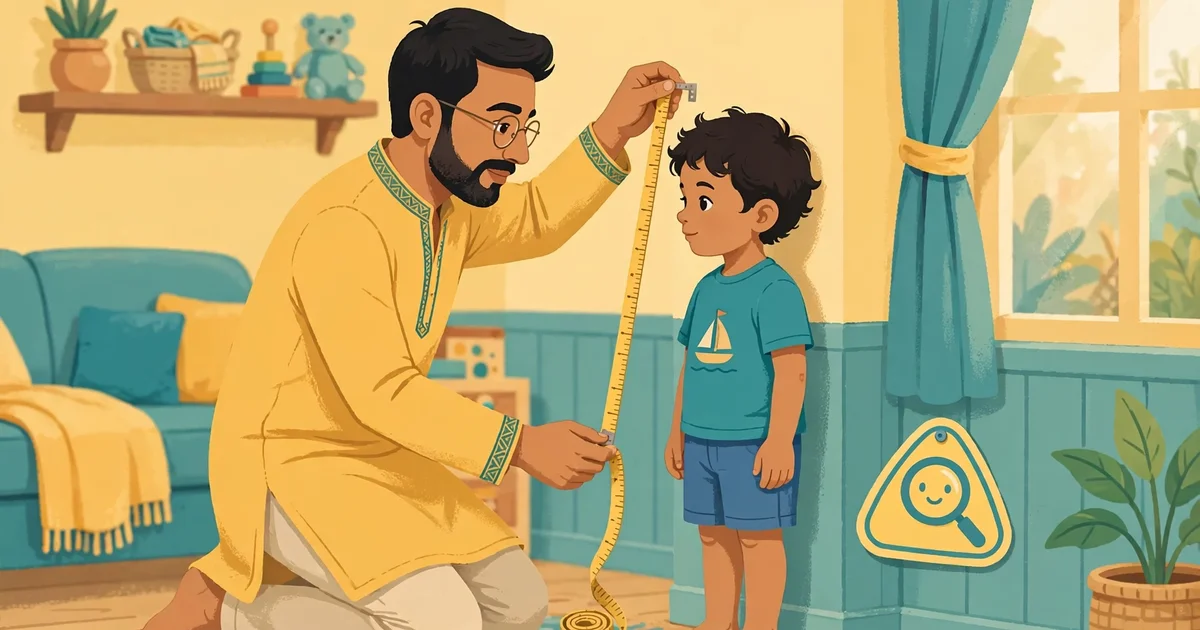
For young children, a small height error has an outsized effect because the calculator judges weight relative to height. Over-measure by 2–3 cm and a healthy child can land in the yellow zone; under-measure and a thin child can look deceptively fine. Measure against a flat wall, barefoot, heels together, back straight, head level — and read at eye level to avoid angle error.
Takeaway: Two careful centimetres beat ten careless ones.
How Does a Wrong Birth Date Affect the Score?
Age decides which WHO curve your child is compared against, and the curves move fast early on. One month off shifts the comparison — for a 6-month-old, a month is a sixth of their life. Always enter the date from an official record (birth certificate or MCP card), double-check the year, and glance at the displayed age to confirm it “feels right.”
👉 Open the Poshan Calculator and verify the displayed age before trusting the result.
Takeaway: The birth date is the most consequential entry — verify it from a document every time.
Why Must Under-2s Be Measured Lying Down?
WHO standards use length (lying down) under 24 months and height (standing) from 24 months — different measurements, different curves. A 15-month-old measured standing typically reads shorter than their true length, distorting the result.
- Under 2: lay baby flat, gently straighten legs, measure crown to heel.
- Two people make this far easier — one steadies the head, one reads.
- From 2 years: switch to standing height against a wall.
Takeaway: Under 2 = lying down, over 2 = standing — the wrong one bends the result.
What Happens When You Mix Up Kg and Grams?
Unit mix-ups cause the wildest errors. Typing 8500 (grams) into a kilograms field tells the calculator the child weighs 8,500 kg. The reverse is equally bad.
- Check the expected unit before typing — usually kilograms with decimals (8.5).
- Convert grams ÷ 1,000 (8,500 g = 8.5 kg); remember 1 inch = 2.54 cm.
- Read the number twice: once from the scale, once from the screen.
Takeaway: A 10-second unit check prevents the most dramatic errors of all.
Why Does Measuring With Clothes On Matter?
Shoes, heavy clothes, and wet diapers add weight that is not the child’s body. A winter outfit can add 300–500 grams — enough to nudge a borderline child from yellow to green and hide a real problem. WHO protocol: minimal clothing, no shoes, no cap.
- Remove shoes, sweaters, jackets, and hair clips; change wet diapers first.
- A light vest or single thin layer is fine; a full winter outfit is not.
- Measure at roughly the same time of day each month.
Takeaway: Clothes are not the child — strip to light clothing for an honest number.
How Do Rounding and Guessing Cause Errors?
“About 80 cm” and “roughly 10 kg” feel harmless, but growth monitoring detects small changes over months — a child gaining 200 g looks stagnant if you round to the nearest kilo. Guessing is worse; human estimates are notoriously unreliable.
- Record weight to one decimal place (10.2 kg), height to the nearest 0.5 cm.
- Never guess — retry tomorrow rather than inventing a number.
- Write the number down immediately; memory edits itself within minutes.
👉 Precise numbers in, trustworthy result out — run the check with careful measurements.
Takeaway: Feed the calculator precise numbers — never rounded guesses.
Why Is the Wrong Sex Selection Such a Big Deal?
Boys and girls follow different WHO curves. The wrong selection compares your child against the wrong curve — and the error is invisible, because the result looks perfectly normal, just wrong. Most common with twins or when one person measures and another enters data. Always confirm the sex field on screen before submitting; when a result surprises you, recheck this field first.
Takeaway: Wrong sex = wrong curve = wrong result that looks right.
7 Steps to an Error-Free Measurement

- Gather a working scale, a flat wall or tape, and the child’s birth record.
- Remove shoes, heavy clothes, and hair accessories; dry diaper for babies.
- Weigh the child and note kilograms to one decimal place.
- Measure length (under 2, lying down) or height (2+, standing), barefoot and straight.
- Write both numbers down immediately — do not trust memory.
- Enter the birth date from the document; confirm sex selection and units.
- If the result surprises you, re-measure once before worrying.
The WHO’s official child growth standards Q&A explains the science behind these protocols. Takeaway: Make this routine a habit and measurement error virtually disappears.
What Should You Do When the Result Surprises You?
A surprising result triggers panic or dismissal — both are mistakes. Run this calm checklist instead: recheck entries (birth date, sex, units, decimals); re-measure with proper technique; consider context (recent illness or diarrhoea temporarily slows growth); look at the 3-month trend; and if the surprise persists next month, visit your Anganwadi worker or doctor.
Remember: the calculator is a screening aid, not a diagnosis. It tells you when to seek professional guidance — a doctor or trained health worker makes the actual assessment.
Takeaway: Surprise → verify → re-measure → watch the trend → seek help if it persists.
Mistake vs. Correct Method at a Glance
| Common mistake | What goes wrong | Correct method |
|---|---|---|
| Guessing birth date from memory | Compared against wrong age curve | Enter date from birth certificate or MCP card |
| Measuring under-2s standing up | Length reads short; result distorts | Lay baby flat, crown to heel |
| Leaving shoes and heavy clothes on | Extra 300–500 g hides undernutrition | Light clothing only, no shoes |
| Mixing up kg/g or cm/inches | Wildly misleading result | Confirm unit first; grams ÷ 1,000 |
| Rounding to “about 10 kg” | Real changes become invisible | Weight to 1 decimal, height to 0.5 cm |
| Selecting the wrong sex | Compared against wrong curve | Verify the sex field before submitting |
| Trusting one reading blindly | Single errors go unnoticed | Re-measure when surprised; log trends |
👉 Key takeaway: Every mistake here is a 10-second fix — correct technique turns the calculator from approximate to genuinely reliable.
FAQs: Getting Accurate Results
Can I use my bathroom scale?
Yes — weigh yourself holding the child, then alone, and subtract. For babies under 6 months, the Anganwadi centre’s baby scale is more accurate.
My child’s height decreased since last month. Possible?
No — children do not shrink. A lower reading means a measuring error. Re-measure carefully.
Does time of day affect measurement?
Slightly — children are a touch taller in the morning and weight varies with feeds. Measure at the same time each month for comparability.
What if I do not know the exact birth date?
Do not guess. Ask your Anganwadi or ASHA worker to help estimate from events or records — an honest estimate beats a confident wrong date.
How do I know my scale is accurate?
Test with a known weight (e.g., a 5-kg rice bag) or compare with the Anganwadi scale occasionally. Replace digital-scale batteries regularly.
Conclusion
Poshan Calculator Mistakes are almost never about the tool — they are about the numbers we feed it. Measure carefully, enter the birth date from a document, confirm units and sex, and re-check surprises.
👉 Measure carefully, then check your child on the free Poshan Calculator — accurate numbers in, trustworthy guidance out.