
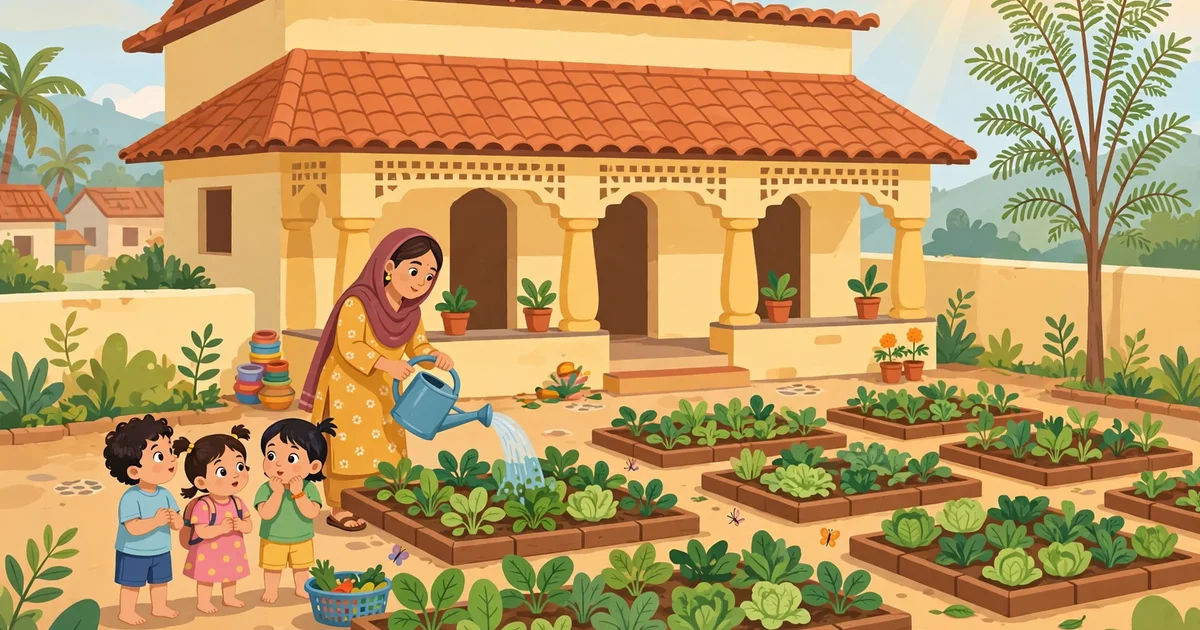
The simple answer is: yes — any Anganwadi centre can set up a Poshan Vatika, a small nutrition garden of leafy greens, vegetables, and fruits, using its courtyard, rooftop, or community land. The harvest can feed directly into the centre’s supplementary nutrition programme, and success needs planning more than money: sunlight, water, and a committed worker.
A Poshan Vatika is a kitchen garden at or near an Anganwadi centre under Poshan Abhiyaan (the Prime Minister’s Overarching Scheme for Holistic Nourishment). Inspired by community efforts like “Harit se Poshan” (greenery for nutrition), these gardens turn unused land into living classrooms — and supply fresh, chemical-free vegetables for daily meals.
👉 While your garden grows, check your child’s growth today with our free Poshan Calculator — WHO (World Health Organization) standards, no download, results in seconds.
In this article, you will understand:
- What a Poshan Vatika is and why every Anganwadi centre benefits from one
- How to choose the site, soil, and layout for your nutrition garden
- Which crops to grow season by season for maximum nutrition
- How to maintain the garden and link it to centre meals and community events
What Is a Poshan Vatika and Why Does It Matter?
A Poshan Vatika is a small plot where an Anganwadi centre grows vegetables, greens, fruits, and medicinal plants for its own use — producing part of what it serves in hot cooked meals and take-home rations instead of depending entirely on markets.
Children who watch a palak (spinach) seed become a plant develop curiosity about food; mothers who help learn practical nutrition; and the centre serves fresher, more diverse meals while saving money — a direct win against anaemia and micronutrient deficiency.
Bottom line: a Poshan Vatika feeds children twice — once with vegetables, and once with knowledge.
Where Can You Set Up the Garden?
You do not need farmland. Most successful centre gardens use one of these spaces:
- Centre courtyard: visible, secure, close to the kitchen; even 100–200 square feet is enough.
- Rooftop: ideal where ground space is scarce; use grow bags, old drums, and raised beds.
- Community or panchayat land: a small allotted patch near the centre, with written permission from the panchayat.
- School or temple land: works when the community is involved and responsibilities are clear.
Check three things first: 5–6 hours of daily sunlight, a nearby water source, and protection from stray cattle.
How Do You Prepare the Soil?
Good soil is the foundation of a productive garden. Most Anganwadi plots need simple improvement before the first sowing:
- Clear weeds and debris, then dig the soil 8–10 inches deep, breaking large clods.
- Mix in well-rotted cow dung manure or vermicompost — about one basket per 50 square feet.
- For hard or clayey soil, add sand and extra compost to improve drainage.
- Level the plot into raised beds (about 3 feet wide) with walking paths between them.
Avoid chemical fertilizers and pesticides — the produce goes to small children, so use only organic methods like compost and neem-based sprays.
Which Crops Should You Grow Season by Season?
Choose crops for nutrition first, ease second. Leafy greens and fast growers give the quickest returns:
- Rainy season (June–September): palak, amaranth (chaulai), okra (bhindi), bottle gourd (lauki), and maize.
- Winter (October–February): spinach, fenugreek (methi), mustard greens (sarson), carrot, radish, cabbage, cauliflower, peas, and coriander.
- Summer (March–May): cluster beans (gawar), cowpea (lobia), pumpkin, cucumber, and heat-tolerant amaranth varieties.
- Year-round perennials: drumstick (moringa) tree, curry leaf plant, papaya, banana, lemon, and guava on the borders.
How Do You Plan the Garden Layout?
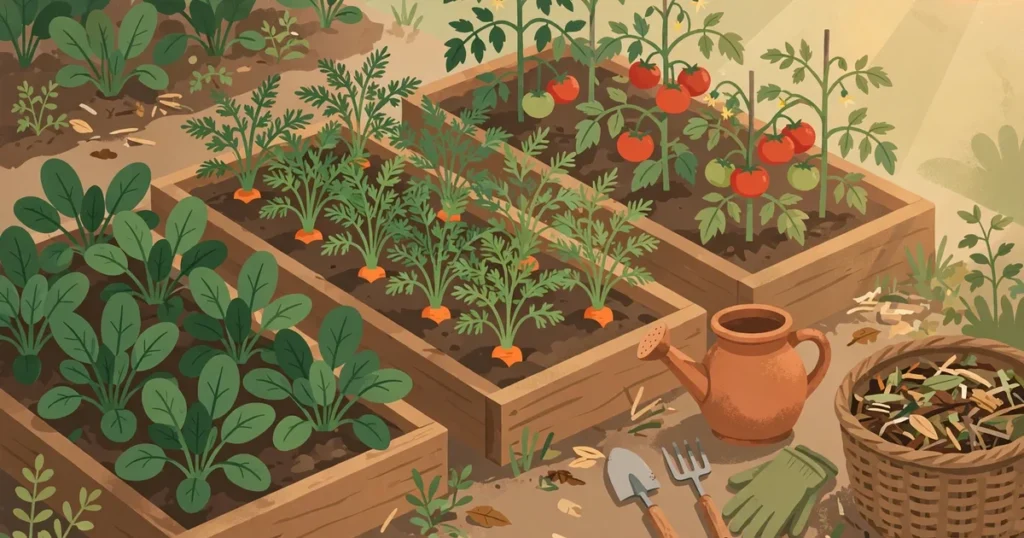
Divide the garden into zones:
- Leafy greens bed: nearest the kitchen — harvested most often.
- Seasonal vegetable beds: rotated each season to keep soil healthy.
- Border plantation: moringa, papaya, and curry leaf trees along the fence line.
- Compost corner: a pit or bin where kitchen waste becomes next season’s fertilizer.
- Water point: a tap, drum, or drip line to minimize carrying distance.
Keep one small “children’s corner” where kids sow and water themselves — it becomes the garden’s most loved spot.
What Does It Cost to Start?
A nutrition garden costs surprisingly little. Here is a realistic comparison:
| Item | Budget start (₹) | Better-equipped (₹) |
|---|---|---|
| Seeds (seasonal vegetables and greens) | 200–300 | 400–500 |
| Compost / cow dung manure | Free–200 (local sourcing) | 300–500 |
| Basic tools (khurpi, spade, watering can) | 300–500 | 800–1,200 |
| Fencing (bamboo/thorn vs wire mesh) | 500–1,000 | 2,000–3,000 |
| Grow bags / containers (rooftop) | 300–500 | 1,000–1,500 |
| Typical total | ₹1,500–2,500 | ₹4,500–6,500 |
👉 Key takeaway: a productive Poshan Vatika can start for less than the cost of a month’s vegetables — the real investment is daily care, not cash.
Who Should Be Involved in the Garden?
A one-person garden rarely survives transfers and leave. Build a small team:
- Anganwadi worker and helper: overall responsibility, daily watering rota.
- Mothers’ groups: weekly shramdaan (voluntary labour) turns maintenance into a community activity.
- Adolescent girls: garden work teaches them nutrition and life skills together.
- Panchayat members: help with land permission, water access, and fencing support.
- Children: sowing, watering, and harvesting — learning by doing.
Link garden days to events: a plantation drive during Poshan Maah (Nutrition Month, every September) or a harvest festival as a Community-Based Event builds visibility and ownership.
How Do You Maintain the Garden Through the Year?
A garden needs rhythm, not heroics:
- Daily: water early morning or evening; check for pests.
- Weekly: weed, loosen soil, harvest what’s ready.
- Monthly: add compost, check fences, plan the next sowing.
- Seasonally: rotate crops, sow green manure, prune perennials.
Save seeds from your best plants each season — desi varieties adapt to your soil and cost nothing.
How Do You Link Garden Produce to Centre Meals?
The garden earns its keep when harvest reaches children’s plates. Coordinate with the cook:
- Share a weekly harvest list so the cook can plan menus around what’s ready.
- Prioritize leafy greens and vitamin-A-rich vegetables for children flagged with anaemia or low weight.
- Use surplus produce for cooking demonstrations with mothers — a live lesson in nutritious recipes.
- Record harvest quantities in a simple register — it proves the garden’s value during inspections.
Note: garden produce supplements the centre’s nutrition programme; it works alongside the official supplementary nutrition, not as a replacement. Growth concerns should always be confirmed with a doctor or health worker.
👉 Pair fresh meals with regular growth checks — the free Poshan Calculator uses WHO standards and stores no data.
What Are the Common Mistakes to Avoid?
Learn from gardens that struggled:
- Starting too big: a small, well-kept plot beats a large, weedy one. Expand only after the first successful season.
- No water plan: gardens die fastest in summer. Secure a reliable source before sowing.
- Skipping the fence: one visit from stray cattle can destroy months of work.
- One-person dependence: if only the worker cares, the garden collapses during her leave. Build the team early.
- Ignoring the soil: feeding plants without feeding the soil gives weak harvests. Compost is non-negotiable.
How Can the Garden Become a Learning Space?
Beyond food, the Poshan Vatika is one of the best teaching tools a centre has:
- Name plants with children in the local language and let them track growth in drawings.
- Use harvest time for lessons on colours, counting, and healthy eating.
- Invite mothers for recipe sessions using garden vegetables — methi theplas, palak dal, drumstick sambar.
- Display a “what’s growing” board at the centre entrance.
For reliable background on child growth benchmarks used alongside nutrition work, see the WHO child growth standards at who.int/tools/child-growth-standards.
FAQs
How much land is needed for a Poshan Vatika?
Even 100–200 square feet of courtyard or rooftop is enough to start; what matters more is sunlight, water access, and protection from animals.
Which is the best plant for an Anganwadi nutrition garden?
The drumstick (moringa) tree — its leaves are rich in iron, calcium, and vitamin A, and it needs little care once established.
Can the garden produce be used in centre meals?
Yes — garden vegetables and greens can supplement the centre’s hot cooked meals, especially for children needing extra nutrition.
Who maintains the Poshan Vatika?
The Anganwadi worker and helper lead it, supported by mothers’ groups, adolescent girls, and panchayat members — shared ownership keeps the garden alive.
Is chemical fertilizer allowed in the garden?
No. Since the produce is eaten by small children, only organic methods — compost, cow dung manure, and neem-based pest control — should be used.
Conclusion
A Poshan Vatika turns idle land into fresh nutrition, practical learning, and community pride. Start small and sunny, enrich the soil, sow hardy greens, protect the plot with a fence and a team — and let the harvest flow into children’s meals. Season by season, the garden repays itself many times over.
👉 Begin your nutrition journey today: grow the garden, and track the results with the free Poshan Calculator — WHO-based growth checks for every Indian family.