
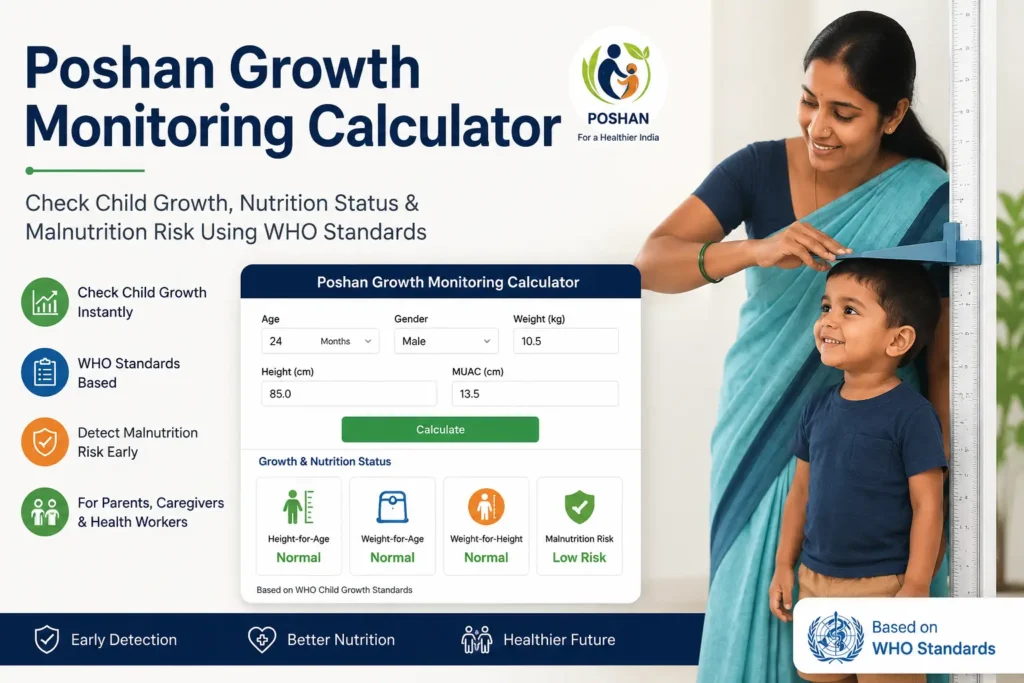
The Poshan Growth Monitoring Calculator helps you track your child’s growth and detect early signs of malnutrition in just a few seconds. It is based on WHO growth standards and gives a clear classification of your child’s nutritional status.
Unlike a simple calculator, this tool is designed for real health screening. It helps identify risks like stunting, wasting, underweight, and Severe Acute Malnutrition (SAM) using height, weight, age, and MUAC-based indicators.
🌱 Poshan Growth Monitoring
Healthy Today, Stronger Tomorrow ❤️
Check your child's growth status using WHO-style indicators
What is the Poshan Growth Monitoring Calculator?
The Poshan Growth Monitoring Calculator is a child health tool that checks a child’s growth status and helps detect early signs of malnutrition using WHO growth standards. It goes beyond simple calculations and works as a basic health screening system for children aged 0–5 years.
It evaluates key indicators such as height, weight, age, and sometimes MUAC (Mid-Upper Arm Circumference) to determine whether a child is growing normally or at risk of conditions such as stunting, wasting, or underweight.
Purpose of growth monitoring in child health
The main purpose of growth monitoring is to track a child’s development over time. Regular monitoring helps identify growth faltering before it becomes severe.
It allows parents and health workers to take early action in case of poor weight gain, delayed height growth, or signs of acute malnutrition.
The difference between a calculator and a monitoring tool
A normal calculator only gives numbers like BMI or basic results based on inputs.
A growth monitoring tool, however, provides a deeper analysis. It not only calculates but also interprets results using WHO growth standards, showing whether a child is at low, moderate, or high nutritional risk.
In simple terms:
- Calculator = gives values.
- Monitoring tool = gives health interpretation.
Why is early detection of malnutrition important?
Early detection of malnutrition is very important because it helps prevent long-term health problems such as stunting, weakened immunity, and delayed development.
Conditions like wasting and Severe Acute Malnutrition (SAM) can become serious if not identified early. Timely screening allows parents and health workers to improve a child’s nutrition, diet, and care before the condition worsens.
How the Growth Monitoring Calculator Works
The Poshan Growth Monitoring Calculator analyzes a child’s basic body measurements and compares them with WHO growth standards.
It quickly converts the input data into a clear nutrition and growth status report, helping identify early signs of malnutrition.
This tool is designed for fast health screening, so parents and health workers can understand a child’s condition in seconds without having to read complex charts.
Data required (age, height, weight, gender, MUAC)
To use the calculator, you need to enter a few simple details:
- Age of the child (in years or months)
- Gender (boy or girl)
- Height (in cm)
- Weight (in kg)
- MUAC (Mid-Upper Arm Circumference) in cm (optional but useful)
These inputs help the tool understand the child’s growth pattern and overall nutritional condition.
WHO growth standards used in the calculation
The calculator uses the WHO (World Health Organization) child growth standards, which are globally accepted guidelines for assessing how a child should grow at different ages.
It evaluates key indicators like:
- Height-for-age (stunting)
- Weight-for-age (underweight)
- Weight-for-height (wasting)
- BMI-for-age (nutrition status)
These standards help classify whether a child is in a normal growth range or showing signs of growth faltering or malnutrition.
How results are generated in real time
Once the data is entered, the tool instantly processes it using WHO-based reference values and simplified growth logic.
It then generates a real-time report showing:
- Growth status (Normal / Risk / Malnutrition)
- Stunting or wasting risk level
- Underweight classification
- Overall nutrition assessment
This immediate output helps parents take quick action if any growth risk is detected, making early malnutrition screening simple and accessible.
Key Growth Indicators Measured
The Poshan Growth Monitoring Calculator evaluates a child’s health using four important WHO growth indicators. These indicators help identify early signs of malnutrition, growth delay, and overall nutritional status in children.
Each indicator focuses on a different aspect of a child’s physical development, providing a complete picture of their growth and health.
Height-for-age (Stunting)
Height-for-age measures a child’s height compared to their age. It is used to detect stunting, which means a child is shorter than expected for their age due to long-term undernutrition or repeated illness.
Stunting is a sign of chronic malnutrition and can affect both physical growth and mental development if left untreated.
Weight-for-height (Wasting)
Weight-for-height compares a child’s weight with their height. It helps identify wasting, which indicates recent or severe weight loss due to poor nutrition or illness.
Wasting is a sign of acute malnutrition and requires immediate attention, as it can quickly become serious if left untreated.
Weight-for-age (Underweight)
Weight-for-age checks whether a child’s weight is appropriate for their age. It helps detect underweight conditions, which may result from either short-term or long-term nutritional problems.
This indicator is commonly used in child growth monitoring programs to track overall development.
BMI-for-age (Nutritional status overview)
BMI-for-age measures a child’s body mass index adjusted for age and gender. It gives an overall view of the child’s nutritional status, including whether they are undernourished, normal, or overweight.
It helps combine height and weight data to better understand a child’s growth balance and health condition.
Understanding Your Child’s Nutrition Status
The Poshan Growth Monitoring Calculator helps you understand your child’s nutrition status by comparing their growth data with WHO growth standards.
It classifies results into clear categories so parents and health workers can quickly identify any risk of malnutrition. This makes it easier to take early action before mild issues turn into serious growth problems.
Normal growth range
A child is considered in the normal growth range when their height, weight, and BMI-for-age are within the expected WHO limits for their age and gender.
This means the child is growing properly, with no signs of stunting, wasting, or underweight conditions. A balanced diet and regular health checkups remain important for maintaining healthy growth.
Moderate malnutrition
Moderate malnutrition means the child’s growth is below the normal range but not yet severe. It may show as mild underweight or early signs of wasting.
At this stage, timely improvements in diet, nutrition, and feeding habits can help restore normal growth before the condition worsens.
Severe malnutrition (SAM)
Severe Acute Malnutrition (SAM) is a serious condition characterized by very low weight-for-height or very low MUAC.
Children with SAM are at high risk of illness, weak immunity, and growth failure. Immediate medical attention and proper nutritional treatment are required in such cases.
Risk categories and warning signs
The calculator also shows risk levels to help with the early detection of problems:
- 🟢 Low risk – Normal growth, no immediate concern
- 🟡 Moderate risk – Early signs of malnutrition
- 🔴 High risk – Possible severe malnutrition or growth failure
Warning signs may include poor weight gain, visible thinness, delayed height growth, or frequent illness. Early identification helps prevent long-term health and developmental issues.
Stunting vs Wasting vs Underweight Explained
The terms stunting, wasting, and underweight are the three main indicators used in the WHO child growth standards to assess malnutrition. Each one describes a different type of growth problem in children and helps identify specific health risks early.
Understanding these differences is important for proper child nutrition monitoring and timely intervention.
What is stunting?
Stunting refers to a child being too short for their age. It is usually caused by long-term undernutrition, poor diet, or repeated infections.
It develops slowly over time and is a sign of chronic malnutrition. Stunting can also affect a child’s brain development, learning ability, and future health if not addressed early.
What is wasting?
Wasting means a child has low weight for their height. It is usually caused by recent or sudden weight loss due to illness or poor nutrition.
It is a sign of acute malnutrition and can become dangerous quickly if not treated. Children with wasting need immediate nutritional support and care.
What is underweight?
Underweight means a child has a low weight for their age. It can be caused by both short-term and long-term nutritional problems.
It is a general indicator of overall poor growth and may include elements of both stunting and wasting, depending on the case.
Key differences between them
These three conditions are often confused, but they measure different aspects of growth:
- Stunting → too short for age (chronic malnutrition)
- Wasting → too thin for height (acute malnutrition)
- Underweight → low weight for age (general growth issue)
Each condition reflects a different type of nutritional imbalance, and early detection helps in improving a child’s growth and overall health.
WHO Growth Standards Used in This Tool
The Poshan Growth Monitoring Calculator is based on the WHO (World Health Organization) child growth standards, which are globally accepted guidelines for assessing how children should grow in a healthy environment.
These standards help compare a child’s height, weight, and age with international reference data to identify early signs of normal growth or malnutrition.
Overview of WHO child growth standards
The WHO child growth standards are a set of scientifically developed reference charts that show how children should grow under ideal health and nutrition conditions.
They are used worldwide by health workers, Anganwadi programs, and pediatric experts to monitor child development.
These standards help identify issues like:
- Stunting (low height for age)
- Wasting (low weight for height)
- Underweight (low weight for age)
What are Z-scores in simple terms?
A Z-score is a simple way to understand how a child’s growth compares to the WHO reference population.
In simple terms:
- It shows whether a child is above, below, or within the normal growth range.
- A score close to 0 means normal growth.
- A very low score indicates possible malnutrition or growth delay.
Z-scores help convert raw measurements into easy-to-understand growth status results.
How the WHO defines malnutrition levels
WHO defines malnutrition levels based on how far a child’s measurements are from the normal growth range.
Common categories include:
- 🟢 Normal growth → healthy development within expected range
- 🟡 Moderate malnutrition → below normal but not severe
- 🔴 Severe malnutrition (SAM) → very low growth indicators needing urgent care
These classifications help in early detection and timely treatment of growth-related health issues in children.
How to Use the Growth Monitoring Calculator
The Poshan Growth Monitoring Calculator is designed to be simple and quick, so parents and health workers can easily check a child’s growth and nutrition status in just a few steps.
It works instantly using WHO growth standards to give clear screening results.
Step 1 — Enter child details
Start by entering the child’s basic details, such as name (optional), age, and gender. These details help the tool apply the correct growth reference standards for accurate results.
Make sure the age is entered correctly, as even small errors can affect the growth classification.
Step 2 — Add height and weight
Next, enter the child’s height (in cm) and weight (in kg).
These two measurements are the most important inputs because they are used to calculate key indicators like BMI-for-age, weight-for-height (wasting), and weight-for-age (underweight).
Accurate measurement ensures a more reliable nutrition screening result.
Step 3 — Select age and gender
Choose the correct age group and gender (boy or girl). The WHO growth standards differ by age and gender, so this step ensures the result matches the appropriate growth chart reference.
This helps the tool compare your child’s data with the right international growth benchmarks.
Step 4 — Get instant growth status
Once all details are entered, click on the calculate button to get instant results. The tool will show your child’s growth status, including whether they are in the normal range or at risk of stunting, wasting, or underweight conditions.
It also provides a simple nutrition interpretation, helping you understand your child’s overall health and growth condition clearly.
When Should You Use This Tool?
The Poshan Growth Monitoring Calculator is useful in many real-life situations where a child’s growth and nutrition status needs to be checked quickly.
It helps parents and health workers identify possible malnutrition risks using the WHO growth standards in a simple way. This tool is especially helpful when regular growth monitoring is needed to detect early signs of stunting, wasting, or underweight conditions.
Routine child growth tracking
This tool can be used during regular growth checkups to track a child’s development over time.
By monitoring height, weight, and BMI-for-age, parents can ensure the child is maintaining a healthy growth pattern according to age.
Suspected malnutrition cases
If a child shows signs such as poor weight gain, weakness, or slow height growth, this tool can help screen for possible malnutrition. It provides an early screening result that indicates whether the child may be at risk of stunting, wasting, or underweight.
Anganwadi / ASHA monitoring support
This calculator is also useful for Anganwadi workers and ASHA workers during field visits or community health programs.
It helps in quick nutrition assessment of children and supports early identification of Severe Acute Malnutrition (SAM) or Moderate Acute Malnutrition (MAM).
Home-based child health check
Parents can use this tool at home to regularly check their child’s growth and nutritional status without needing medical charts or complex calculations.
It provides a simple way to understand whether a child is growing within the normal WHO growth range or showing signs of growth concern.
Warning Signs of Poor Child Growth
The Poshan Growth Monitoring Calculator helps identify early signs of poor child growth and possible malnutrition. In addition to using the tool, parents should also watch for physical and behavioral warning signs that may indicate problems with a child’s nutrition and development.
Early detection of these signs can prevent serious conditions like stunting, wasting, and Severe Acute Malnutrition (SAM).
Sudden weight loss
A sudden drop in a child’s weight is one of the first warning signs of acute malnutrition. It may occur due to illness, a poor diet, or a lack of proper nutrition.
If a child is losing weight quickly, it should be checked immediately using a growth monitoring tool or medical advice.
Delayed height growth
If a child is not growing in height according to age, it may be a sign of stunting. This usually develops slowly due to long-term undernutrition or repeated infections.
Delayed height growth should not be ignored, as it can affect a child’s physical and mental development over time.
Weak immunity / frequent illness
Children with poor nutritional status often have a weak immune system, making them more likely to fall sick frequently. Common issues include repeated fever, infections, and slow recovery, which can also impact overall growth and weight gain.
Visible thinness or swelling
Extreme thinness in arms, legs, or face may indicate wasting or Severe Acute Malnutrition (SAM).
In some cases, swelling in the body (especially feet or face) can also be a serious sign of protein deficiency and malnutrition, requiring immediate attention.
How to Improve Child Growth Naturally
Improving a child’s growth and nutrition status requires a consistent focus on a balanced diet, proper feeding habits, and good hygiene. The goal is to support healthy development and prevent conditions like stunting, wasting, and underweight in early childhood.
Along with using the Poshan Growth Monitoring Calculator, these natural methods can help improve a child’s overall WHO-based growth indicators.
Balanced nutrition plan
A balanced diet is the foundation of healthy child growth. It should include the right mix of carbohydrates, proteins, healthy fats, vitamins, and minerals.
Meals should be planned to support steady weight gain and height development, without relying on processed or low-nutrient foods.
Protein and micronutrient foods
Protein-rich foods like milk, eggs, pulses, lentils, and meat help build strong muscles and support weight-for-height growth. Micronutrients such as iron, zinc, calcium, and vitamin A are also very important for preventing malnutrition and growth delays.
Including a variety of nutrient-rich foods helps improve both BMI-for-age and overall growth performance.
Feeding frequency tips
Children need to eat small but frequent meals throughout the day to maintain steady energy and nutrition levels.
Skipping meals or long gaps between feedings can lead to poor weight gain and a risk of wasting. Regular feeding helps maintain a healthy growth pattern according to age.
Hygiene and health practices
Good hygiene practices play a key role in preventing infections that can affect a child’s growth and nutrient absorption.
Simple habits like handwashing, clean drinking water, and safe food preparation reduce the risk of illness and support better nutritional health and immunity.
Common Mistakes in Growth Monitoring
Many parents and even caregivers make simple mistakes when checking a child’s growth and nutritional status, which can lead to incorrect growth-monitoring results.
Avoiding these errors is important for accurate assessment using the Poshan Growth Monitoring Calculator and WHO growth standards.
Incorrect age measurement
One of the most common mistakes is entering the wrong age of the child. Even a small error in age can alter the growth classification, especially for indicators such as height-for-age and weight-for-age.
Always ensure the child’s age is entered correctly, preferably in months for younger children (0–5 years), for more accurate results.
Inaccurate height/weight readings
Incorrect height or weight measurements can significantly affect the results of BMI, wasting, and underweight status.
Using improper tools, failing to measure properly, or rounding values can lead to false nutrition status reports. Always use a proper measuring scale and ensure the child is measured correctly.
Ignoring early warning signs
Many parents ignore early signs of poor growth, such as slow weight gain, weakness, or reduced appetite.
These early signs can indicate stunting, wasting, or undernutrition, and delaying action may worsen the child’s health and development outcomes. Early monitoring helps prevent serious malnutrition conditions.
FAQs
Here are some common questions about the Poshan Growth Monitoring Calculator and how it helps in child growth tracking and malnutrition screening using the WHO growth standards.
What is growth monitoring in children?
Growth monitoring is the regular tracking of a child’s height, weight, and overall development over time. It helps identify whether a child is growing normally or showing early signs of malnutrition, stunting, or wasting.
It is an important part of child health care, especially in the first 0–5 years of life.
Is this calculator based on WHO standards?
Yes, the Poshan Growth Monitoring Calculator is based on the WHO (World Health Organization) child growth standards.
These standards are globally accepted and are used to compare a child’s growth indicators, like height-for-age, weight-for-age, and weight-for-height, against healthy reference data.
How accurate is the Poshan Growth Monitoring Calculator?
The calculator provides a reliable screening-based estimate using WHO growth indicators and simplified assessment logic.
While it is highly useful for early detection of malnutrition, it is not a diagnostic tool. For confirmed results, a doctor or health professional should always be consulted.
Can it detect SAM and MAM?
Yes, the tool can help identify the risk of Severe Acute Malnutrition (SAM) and Moderate Acute Malnutrition (MAM) using indicators such as weight-for-height and MUAC.
It acts as an early screening system to alert users about potential nutrition risks.
Who should use this tool?
This tool is designed for:
- Parents who want to monitor their child’s growth at home
- Anganwadi and ASHA workers for field screening
- Health awareness programs for quick assessment
It is especially useful for children aged 0–5 years to track early growth and nutrition development.
Conclusion
The Poshan Growth Monitoring Calculator is a simple but powerful tool for tracking a child’s growth and nutritional health. It helps parents and health workers quickly understand whether a child is growing within a healthy range according to the WHO growth standards.
Importance of regular growth monitoring
Regular growth monitoring is very important to ensure a child is developing properly in terms of height, weight, and overall nutrition. By checking growth frequently, parents can detect early signs of stunting, wasting, or underweight conditions before they become serious.
Consistent monitoring also supports better diet planning and timely health decisions for the child.
Early detection saves child health outcomes.
Early detection of malnutrition can make a big difference in a child’s life. Identifying issues such as Severe Acute Malnutrition (SAM) or Moderate Acute Malnutrition (MAM) at an early stage enables faster treatment and better recovery.
Using tools like this calculator helps improve long-term child health, immunity, and development outcomes, ensuring a healthier future.